
Cable insulation resistance testing is one of the most basic and effective methods to evaluate cable health. It reflects the insulation condition between conductors and between conductors and ground, and can expose hidden problems such as dampness, aging, contamination and mechanical damage before a short circuit or breakdown accident occurs.
🧪 Key Point: Insulation resistance testing is not only a routine acceptance item after cable laying, but also an important means of preventive maintenance. A single low resistance reading may indicate potential safety hazards rather than just data deviation.
1. What Is Cable Insulation Resistance Testing?
Insulation resistance testing measures the resistance value of the cable insulation layer by applying a certain DC voltage between the conductor and the sheath, or between different conductors. The test result is usually expressed in megohms and reflects whether the insulation material still maintains good electrical isolation performance.
Unlike load current testing, insulation resistance testing is performed under no-load or offline conditions. It is especially suitable for newly laid cables, old lines after long-term operation, and fault sections that need to be re-evaluated before re-operation.
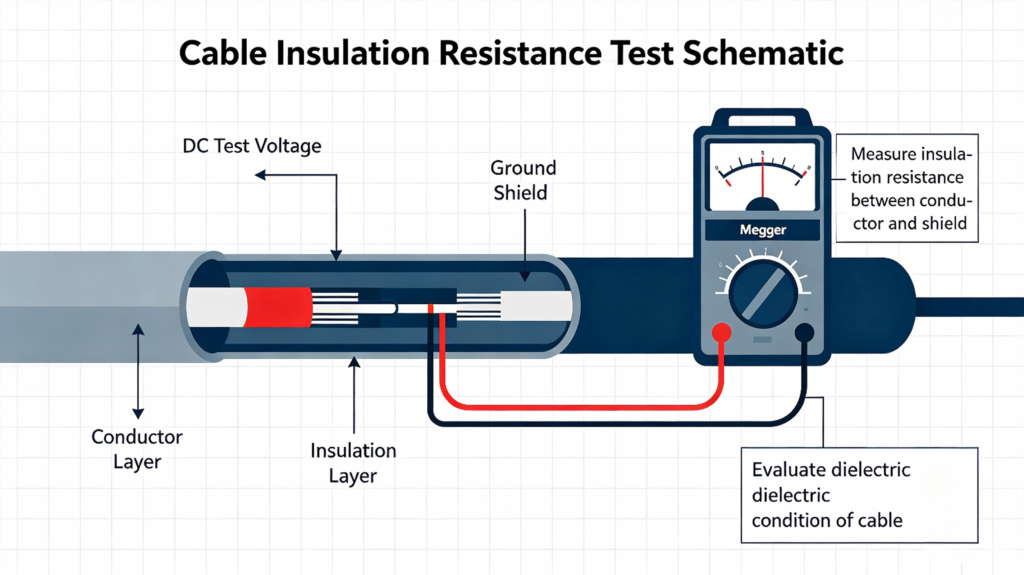
2. Common Test Instruments and Methods
Field insulation resistance testing mainly uses megohmmeter, also known as a megger. Different test voltages are selected according to cable voltage level and insulation material. The following methods are commonly used:
- Spot Test: Test the insulation resistance at a specific moment to quickly judge whether the cable is obviously abnormal. Suitable for initial screening after fault occurrence.
- Timed Test: Record readings at 15 seconds, 30 seconds and 60 seconds, and observe the change trend. It helps distinguish between temporary dampness and continuous insulation deterioration.
- Polarization Index Test: Compare the 10-minute reading with the 1-minute reading to evaluate the aging degree of insulation. Higher values generally indicate better insulation condition.
- Comparison Test: Compare the test results with historical data, adjacent cables or factory values. Sudden drop is usually an important warning signal.
3. Reference Standards and Judgment Values
Insulation resistance judgment cannot rely solely on a fixed value. It should be combined with cable voltage level, insulation material, ambient temperature and historical data. The following table provides general field reference standards:
| Cable Type | Test Voltage | Minimum Recommended Insulation Resistance | Field Judgment |
|---|---|---|---|
| Low voltage power cable | 500V DC / 1000V DC | ≥ 100 MΩ | Below 100 MΩ should be further checked |
| Medium voltage cable | 2500V DC / 5000V DC | ≥ 1000 MΩ | Low reading indicates dampness or aging |
| Control cable | 500V DC | ≥ 50 MΩ | Affected by terminal dampness and contamination |
| Newly laid cable | According to voltage level | Refer to factory value | Significant drop compared with factory value needs attention |
4. Low Insulation Resistance: Main Causes
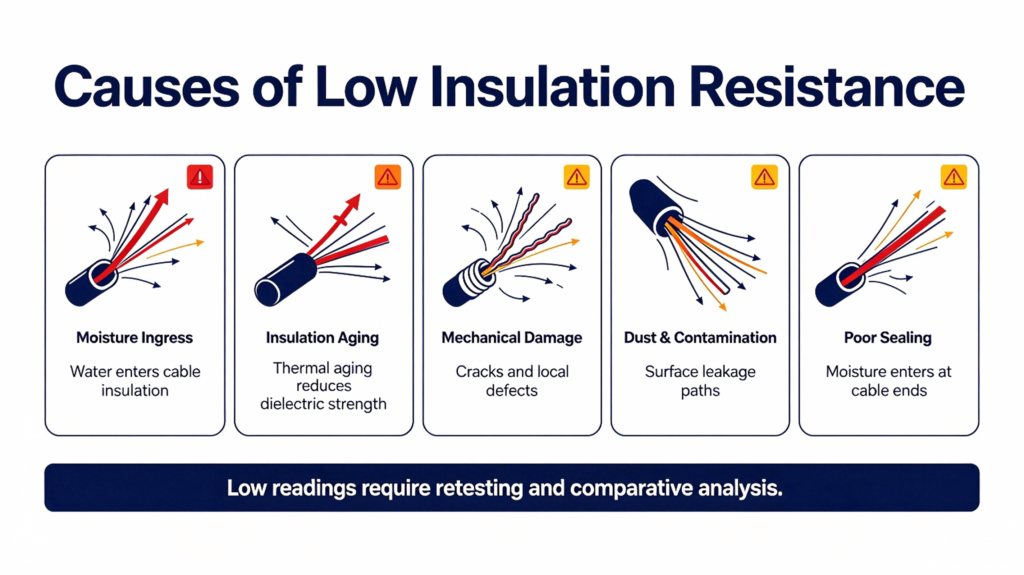
A low insulation resistance reading does not always mean cable quality failure. It may be caused by on-site environment, construction quality or long-term operation. Common causes include:
- Moisture ingress: Water immersion in cable trench, poor sealing of joints, damp terminals and humid environment will significantly reduce insulation resistance.
- Insulation aging: Long-term thermal aging, overheating load and chemical corrosion cause insulation material performance to decline gradually.
- Mechanical damage: External extrusion, construction excavation and bending damage lead to insulation cracks or local defects.
- Dust and contamination: Conductive dust, salt spray and chemical deposits on cable surfaces and terminals may cause surface leakage.
- Improper storage and laying: Cable ends are not sealed during transportation and laying, allowing moisture to enter the insulation layer.
5. Field Testing Precautions
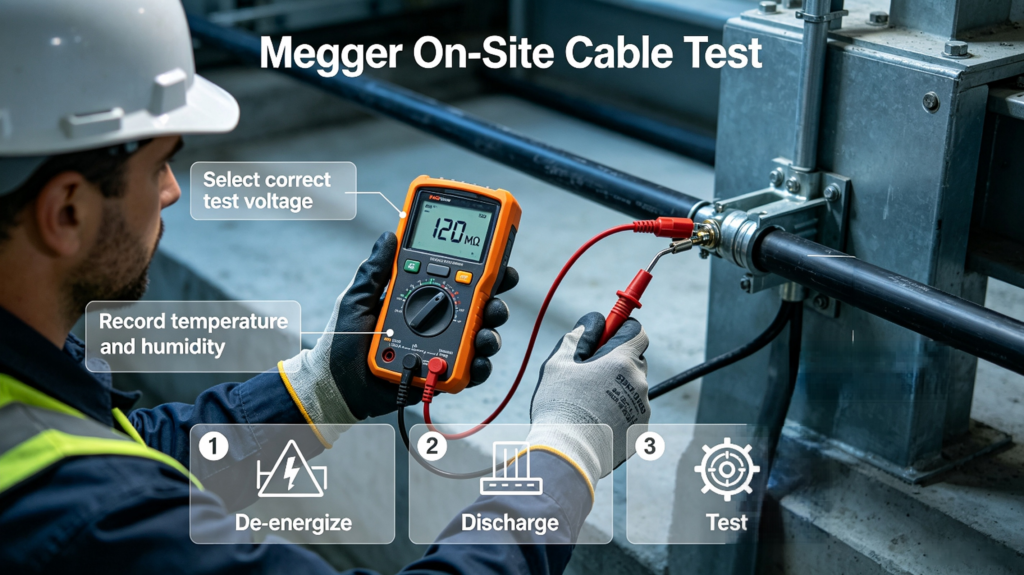
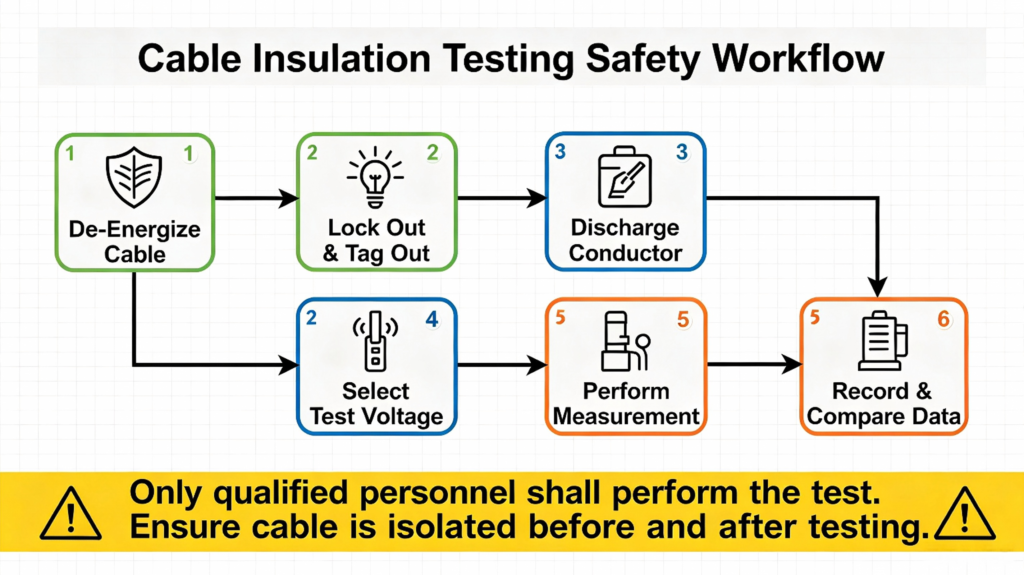
⚠️ Safety Reminder: Insulation resistance testing must be performed by qualified personnel. The cable must be fully de-energized, discharged and isolated before testing to avoid electric shock or equipment damage.
- Confirm that the cable is completely de-energized before testing.
- Discharge the cable conductor to ground before and after testing.
- Select appropriate test voltage according to cable voltage level.
- Record temperature, humidity, test location and cable name for data comparison.
- If the reading is unstable, check terminals, joint boxes and cable ends first.
- Do not judge a single failure only by one test result; perform retesting and comparative analysis.
6. Conclusion
Cable insulation resistance testing is an important preventive maintenance method that can detect hidden faults such as dampness, aging, contamination and mechanical damage before cable failure. It is suitable for newly laid cables, operating lines and post-fault re-inspection projects.
In actual engineering, test results should be comprehensively judged according to voltage level, historical data, environmental conditions and comparison with similar circuits. When insulation resistance continues to be low or drops sharply, the cable should be inspected, repaired or replaced in time.
FAQ About cable insulation resistance
A1: It is a common field test to measure the insulation condition of cables, checking whether the insulation layer keeps good electrical isolation performance.
A2: IEC standards are widely adopted. The test judges insulation quality by measuring resistance values under specified test voltage and temperature.
A3: Compare the measured insulation resistance with standard requirements. If the value meets or exceeds the required minimum, the cable insulation is acceptable.
Insulation resistance testing is an indispensable inspection step to avoid leakage and short-circuit risks before cable putting into use. Regular testing helps find hidden aging problems in advance.
If you need cables with stable insulation performance for your engineering projects, Yidong Crosslinked Cable offers reliable power cables and technical support. Contact us for datasheets and quotations.