
Industry Data: More than 65% of long-term underground cable failures are caused by gradual water ingress rather than mechanical damage. Moisture erosion forms water trees inside insulation, leading to latent breakdown faults within 3–5 years.
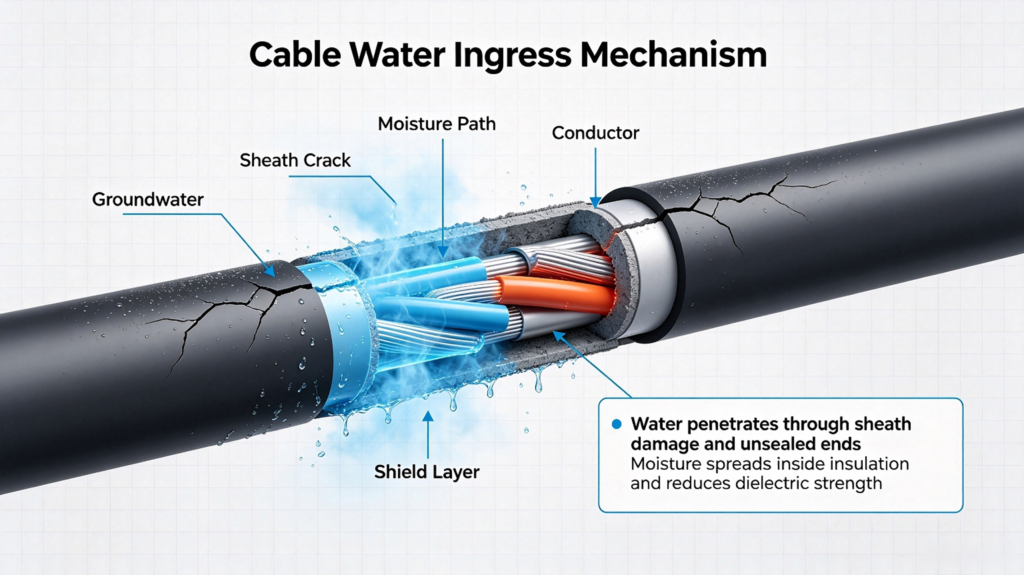
Cable water ingress is one of the most common latent faults in buried, trench-laid and outdoor power cables. Water or humid air penetrates into the cable interior through broken sheaths, unsealed ends and loose joints. Unlike visible damage, moisture erosion is slow and cumulative, which will gradually destroy insulation performance and cause sudden power failure in wet seasons.
Many engineering teams ignore cable waterproof sealing during construction and daily maintenance. This article systematically explains the causes and core hazards of cable water ingress, field detection methods and standardized waterproof protection measures, helping projects eliminate moisture-induced cable hidden dangers.
1. Main Causes of Cable Water Ingress
Cable moisture intrusion is mainly derived from construction defects, aging failure and harsh laying environments. The four most common engineering causes are as follows:
- Unsealed cable ends: Cable ends are not sealed during transportation, stacking and laying. Open ends directly absorb underground and atmospheric moisture, resulting in overall damp insulation.
- Damaged outer sheath: External construction excavation, extrusion and friction cause tiny sheath cracks. Rainwater and groundwater penetrate into the cable along micro gaps.
- Poor joint sealing: On-site cable intermediate joints and terminal heads have unqualified sealing technology, leaving gaps for humid air and water infiltration.
- Long-term waterlogged laying environment: Cable trenches, pipe corridors and underground pits are flooded for a long time. Continuous humidity erodes the cable sheath and penetrates inward.
2. Core Hazards of Cable Moisture Ingress
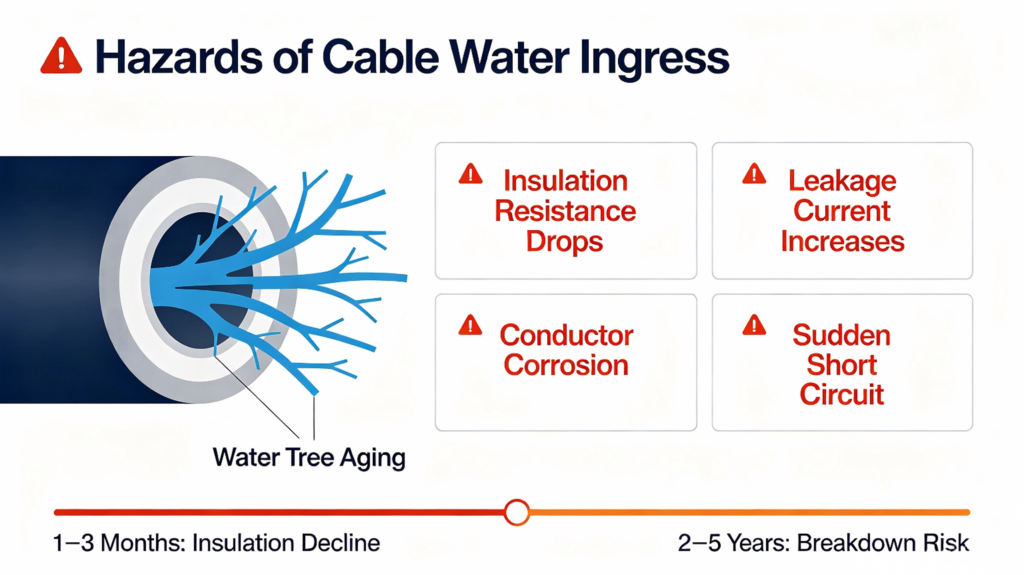
Water ingress does not cause immediate faults, but forms irreversible internal damage. Long-term moisture erosion will trigger a series of insulation deterioration problems:
| Damaged Dimension | Specific Failure Performance | Failure Cycle |
| Insulation Performance Decline | Insulation resistance drops sharply, leakage current increases, and line stability deteriorates | 1–3 months |
| Water Tree Aging Breakdown | Moisture forms conductive water tree branches inside XLPE insulation, causing partial discharge | 2–5 years |
| Corrosion of Conductor and Shield Layer | Water and air oxidation corrode copper/aluminum conductors, increasing line resistance | 3–6 months |
| Sudden Short Circuit Fault | Severe damp insulation breaks down, triggering phase-to-ground short circuit and power outage | 3–5 years |
3. On-Site Detection Methods for Water-Infiltrated Cables
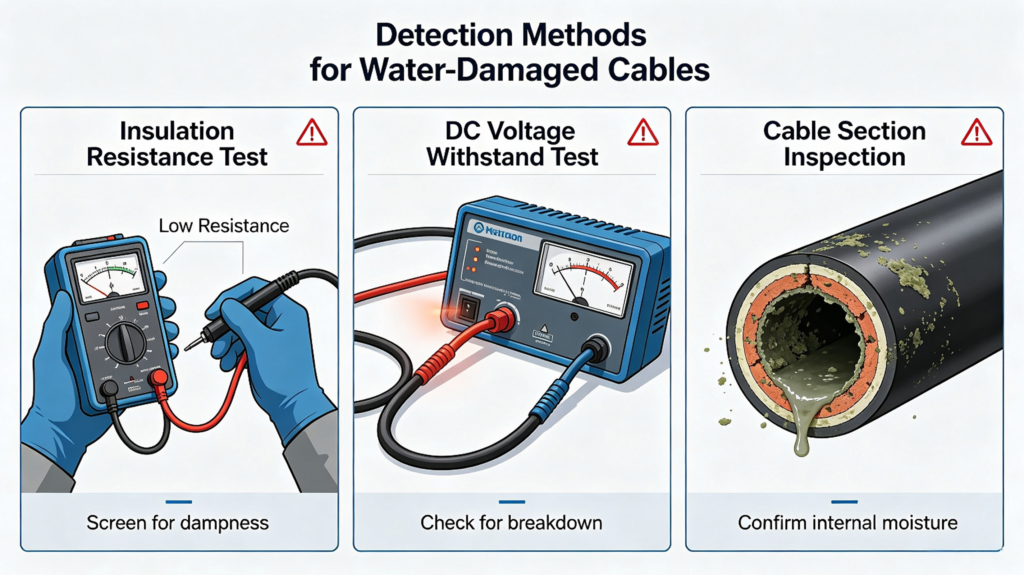
Water-damaged cables have no obvious surface features and need professional testing to judge hidden damp faults. The following three methods are commonly used in engineering:
- Insulation Resistance Test: Use a megohmmeter to detect insulation resistance. A continuous low resistance value indicates internal moisture ingress, which is the most intuitive screening method.
- DC Voltage Withstand Test: Perform pressure resistance detection on the cable. Damp cables are prone to flashover and breakdown during the test.
- Cable Section Inspection: Cut off the suspicious cable section. Visually check whether the interior is damp, waterlogged or mildewed for accurate judgment.
4. Standard Waterproof Protection Solutions for Cables
Core Reminder: Cable waterproofing focuses on prevention rather than remedy. Once water enters the cable interior, most insulation damage is irreversible and cannot be completely repaired.
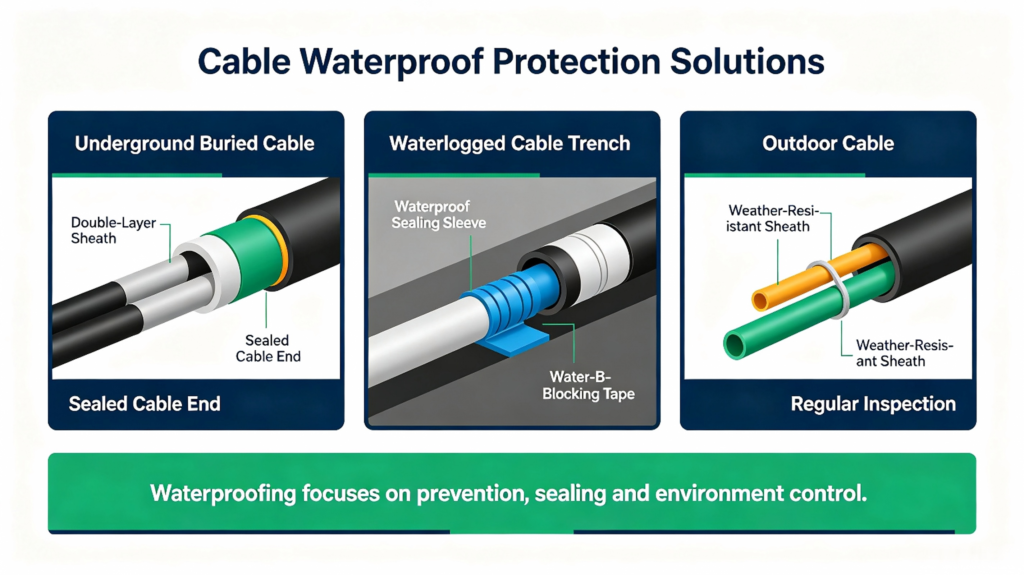
Targeted waterproof protection should be implemented according to laying scenarios. Standard engineering solutions are divided into material selection, construction specification and daily protection:
| Laying Scenario | Waterproof Protection Measures | Engineering Effect |
| Underground buried cable | Adopt double-layer sheath waterproof cables; seal cable ends completely during construction | Prevent groundwater penetration for long-term operation |
| Waterlogged cable trench | Add waterproof sealing sleeves and drainage measures; use water-blocking tape for joints | Isolate humid environment and avoid continuous damp erosion |
| Outdoor overhead cable | Use weather-resistant and waterproof outer sheath; regularly check sheath damage and aging | Resist rainwater immersion and ultraviolet aging |
5. Daily Maintenance Rules to Avoid Cable Water Ingress
- Keep cable ends sealed at all times during transportation, storage and construction to prevent moisture inhalation.
- Strictly standardize cable joint production and sealing process to eliminate infiltration gaps.
- Regularly inspect cable trenches and pipe corridors to clean up water accumulation in time.
- Replace damaged and aging cable sheaths in time to avoid secondary water ingress faults.
FAQ About cable insulation resistance
A1: Cable water ingress is mainly caused by unsealed cable ends, damaged outer sheath, unqualified joint sealing and long-term operation in waterlogged and humid environments.
A2: Slight damp cables can be dried and tested before reuse. Cables with obvious water accumulation and decreased insulation resistance must be replaced to avoid breakdown faults.
A3: Adopt waterproof cable materials, standardize end and joint sealing construction, keep the laying environment dry, and conduct regular insulation testing.
7. Conclusion
Cable water ingress is a hidden progressive fault that seriously endangers the safe operation of power lines. Long-term moisture erosion will cause insulation aging, water tree discharge and sudden short-circuit power outages. Standardized waterproof construction, high-quality waterproof cable selection and daily environmental maintenance are key measures to avoid moisture-induced faults.
If you need high-quality waterproof, moisture-proof and aging-resistant power cables for underground, outdoor and humid engineering projects, Yidong Crosslinked Cable provides full-specification waterproof cable solutions. We support customized selection and professional technical services, contact us for detailed datasheets and project quotations.