
Industry Data: More than 68% of long-distance power supply instability, motor underpower and equipment startup failure problems are caused by excessive cable voltage drop, rather than insufficient power capacity. Unreasonable wire gauge selection and overly long laying distance are the two main hidden causes.
Voltage drop is an inevitable electrical phenomenon during cable power transmission. When current flows through cable conductors, resistance and impedance will cause continuous voltage loss from the power supply end to the load end. A reasonable voltage drop range ensures stable equipment operation, while excessive voltage drop will lead to insufficient load voltage, equipment overheating, low efficiency, and even long-term electrical damage.
In residential electricity, industrial power distribution and long-distance municipal transmission projects, many engineers only focus on cable ampacity and ignore voltage drop limits, resulting in frequent operational failures. This article systematically explains the core causes of voltage drop, industry allowable standards, practical calculation logic and common engineering compensation measures, providing reliable guidance for long-distance cable selection.
1. Core Causes of Cable Voltage Drop
Voltage drop is mainly affected by conductor resistance, cable length, load current and operating environment. The four key influencing factors in actual engineering are as follows:
- Excessive Laying Distance: Voltage loss increases linearly with cable length. Long-distance overhead lines and buried trunk lines are most prone to excessive voltage drop, which is the primary cause of terminal voltage instability.
- Insufficient Cable Cross-Section: Smaller wire gauges have larger conductor resistance. When the load current is large, the resistance heat loss increases significantly, resulting in obvious voltage attenuation.
- Long-Term Heavy Load Operation: The higher the operating current, the greater the voltage drop. Frequent full-load and overload operation will continuously increase line voltage loss.
- Conductor Material Difference: Aluminum cables have higher resistivity than copper cables. Under the same length and cross-section conditions, aluminum cables produce larger voltage drop, which is more obvious in long-distance transmission.
2. Industry Allowable Voltage Drop Standards
Different power supply scenarios have clear safe voltage drop limits. Exceeding the standard will cause operational risks. The following values are universal international engineering allowable ranges:
| Power Supply Scenario | Allowable Voltage Drop | Engineering Risk Description |
| Ordinary residential terminal lighting & socket circuit | ≤ 3% | Excessive drop causes dim light, unstable electrical equipment operation |
| Industrial equipment, motor power circuit | ≤ 5% | Excessive drop leads to motor underpower, heating and burnout |
| Long-distance trunk transmission line | ≤ 5% | Long-term voltage deviation causes power loss and unstable system voltage |
| Precision instrument & emergency power supply circuit | ≤ 2% | Strict voltage stability required to avoid equipment data error and failure |
3. Voltage Drop Comparison: Copper vs Aluminum Cables
Conductor resistivity directly determines voltage loss. Copper and aluminum cables show obvious differences in long-distance transmission effects, which is an important basis for material selection:
| Comparison Item | Copper Cable | Aluminum Cable | Engineering Conclusion |
| Conductor Resistivity | Low resistivity, low loss | 35%–40% higher than copper | Aluminum cables have significantly higher voltage drop |
| Long-distance transmission performance | Stable voltage, small attenuation | Obvious terminal voltage drop | Copper cables are preferred for distances over 100m |
| Load adaptability | Suitable for heavy-load & precision circuits | Only suitable for low-load long trunk lines | Aluminum cables are not recommended for terminal power supply |
4. Common Hazards of Excessive Voltage Drop
Core Engineering Reminder: Voltage drop problems are hidden and cumulative. Short-term slight deviation has no obvious impact, but long-term operation will cause equipment aging acceleration and increased power consumption costs.
- Mechanical equipment failure: Insufficient terminal voltage causes motors to fail to start, run weakly, generate heat severely, and even burn windings.
- Increased line power consumption: Excessive voltage loss is converted into thermal energy loss, resulting in increased enterprise electricity bills for a long time.
- Unstable power supply quality: Voltage fluctuation causes precision instruments to work abnormally, data deviation and equipment crash.
- Cable aging acceleration: Low voltage and high current operation increases cable temperature rise, accelerating insulation aging and shortening line service life.
- Low power supply efficiency: The effective power obtained by the load decreases, resulting in low overall power distribution system efficiency.
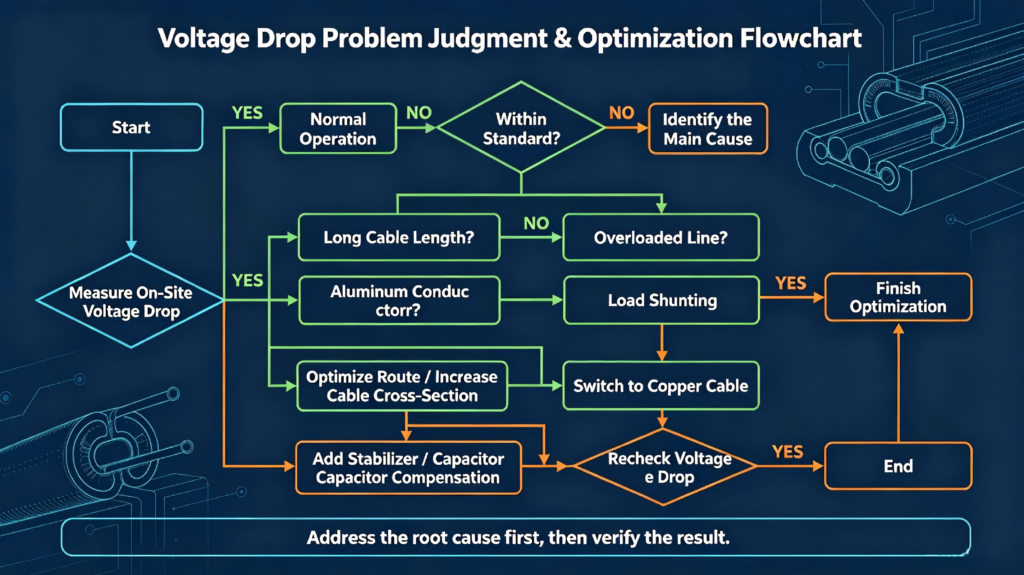
5. Practical Voltage Drop Compensation & Optimization Solutions
For projects with long-distance laying, heavy load and large voltage loss, the following targeted optimization measures can effectively control voltage drop within the standard range. We divide solutions into fundamental solution and auxiliary solution for clearer engineering application:
✅ Fundamental Solutions (Primary Priority)
- Increase cable cross-section reasonably: Properly enlarging the wire gauge can reduce conductor resistance, which is the most direct and effective way to reduce voltage drop for long-distance lines.
- Priority to use copper conductors: For key power supply and long-distance terminal lines, replace aluminum cables with low-resistance copper cables to stabilize terminal voltage.
- Optimize laying route: Reduce unnecessary circuit bending and redundant length, shorten the actual power transmission distance, and reduce line loss.
⚙️ Auxiliary Compensation Solutions (Secondary Optimization)
- Install voltage compensation equipment: Configure reactive power compensation capacitors and voltage stabilizers for industrial heavy-load lines to suppress voltage attenuation and fluctuation.
- Reasonable load shunting: Avoid single-line heavy-load operation, disperse the load current, and reduce voltage loss caused by over-current.
6. Conclusion
Cable voltage drop is a key indicator that determines power supply stability and equipment operating safety. Excessive laying distance, insufficient wire gauge and unreasonable conductor material selection are the main causes of ultra-standard voltage drop. Different engineering scenarios have strict allowable voltage drop limits.
Through scientific wire gauge selection, material matching, route optimization and reactive power compensation, the line voltage loss can be effectively controlled within a safe range, ensuring stable power supply quality, reducing equipment failure rate and long-term power consumption loss.
FAQ About cable insulation resistance
A1: Voltage drop is mainly caused by conductor resistance, cable length, load current and operating temperature. Longer cables and higher current will create more obvious voltage loss.
A2: Most engineering projects adopt IEC standards for voltage drop calculation. It calculates loss based on conductor resistance, reactance, current and cable routing.
A3: Increase conductor cross-sectional area, shorten cable laying distance, reduce load current or use conductors with higher conductivity to compensate voltage drop.
Cable voltage drop is a key factor for project design. Excessive voltage drop may affect equipment operation. Proper conductor size selection is essential to keep the power system stable.
If you need help with cable selection and voltage drop calculation for your project, Yidong Crosslinked Cable provides technical support and matched power cables. Contact us for datasheets and quotations.