
Industry Data: More than 60% of early cable insulation cracks and internal hidden faults are caused by excessive bending during installation. Improper bending does not cause immediate failure but reduces cable service life by more than 40%.
Cable bending radius is the most basic and critical control parameter during cable laying and installation. Each type of power cable has a fixed minimum bending radius requirement. On-site over-bending, sharp-angle turning and forced bending will cause irreversible damage to the cable sheath, insulation layer and internal conductor structure.
Many construction teams only focus on laying speed and ignore bending specifications, resulting in hidden dangers such as insulation micro-cracks, conductor distortion and partial discharge. This article systematically introduces universal cable bending radius standards, typical construction errors and standardized laying guidelines to help standardize on-site cable installation.
1. What Is Cable Bending Radius?
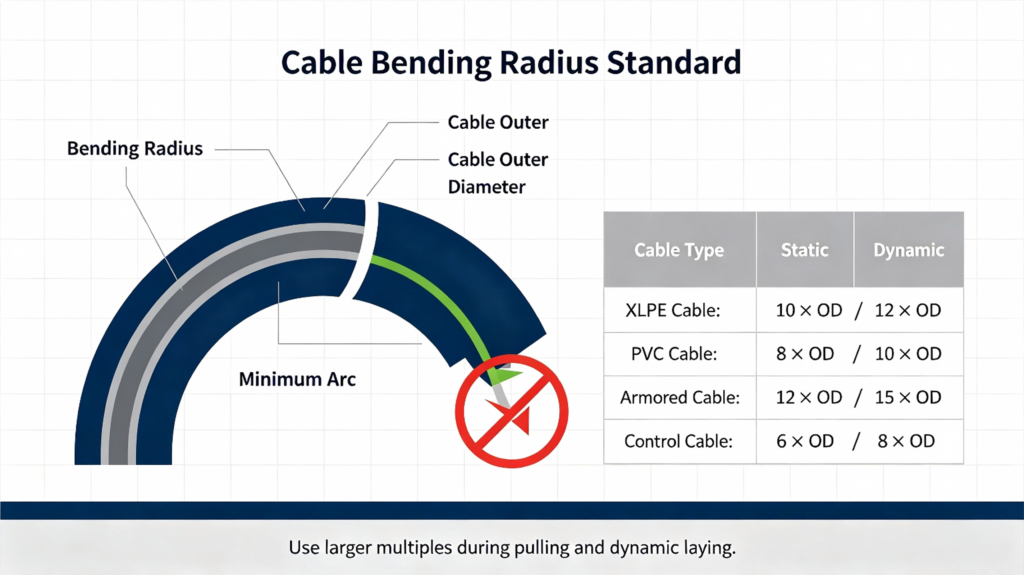
The cable bending radius refers to the minimum arc radius allowed when the cable is turned and bent during laying. It is usually calculated based on the cable outer diameter (OD). All power cables have strict minimum bend limits to protect the internal insulation and shielding structure from extrusion and tensile damage.
If the actual bending radius is smaller than the specified standard, the outer sheath will be stretched, the inner insulation will be squeezed, and tiny cracks will appear inside the insulation layer. These invisible defects will gradually expand during long-term operation and eventually cause breakdown faults.
2. Universal Minimum Bending Radius Standards for Common Cables
Different cable structures and insulation materials correspond to different minimum bending multiples. The following are widely adopted international engineering standards for on-site construction:
| Cable Type | Minimum Bending Radius (Static Installation) | Minimum Bending Radius (Dynamic Laying) | Key Reminder |
| Ordinary XLPE power cable | 10× cable outer diameter | 12× cable outer diameter | Most widely used in industrial and civil projects |
| PVC insulated cable | 8× cable outer diameter | 10× cable outer diameter | Poor low-temperature bending resistance |
| Armored power cable | 12× cable outer diameter | 15× cable outer diameter | Rigid structure, easy to crack if bent sharply |
| Control cable | 6× cable outer diameter | 8× cable outer diameter | Flexible structure, suitable for dense wiring |
3. Hidden Damages Caused by Non-Standard Bending
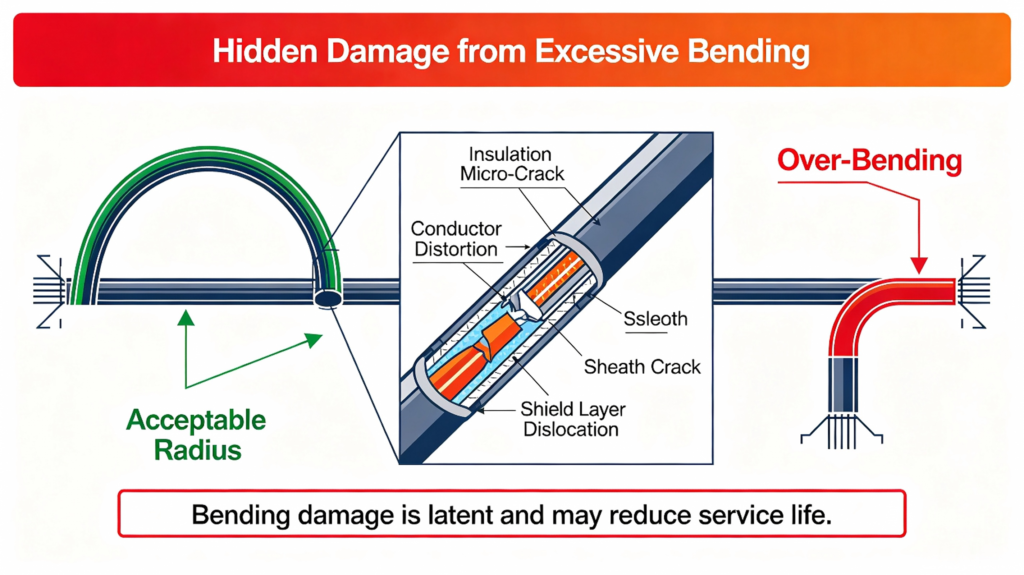
Core Reminder: Bending damage is latent damage. The cable can work normally after laying, but it will fail prematurely after 1–3 years of operation.
- Insulation micro-crack generation: Excessive bending causes tensile and compressive deformation of the insulation layer, producing invisible micro-cracks. Moisture and dust easily invade, inducing water tree aging.
- Conductor structural distortion: Sharp bending leads to local extrusion of the conductor, uneven current distribution, increased local temperature and accelerated aging.
- Shield layer dislocation and damage: For medium-voltage cables, non-standard bending causes shield layer offset, resulting in partial discharge and electric field concentration.
- Sheath cracking and water ingress: Severe bending directly cracks the outer sheath, destroying the waterproof structure and causing long-term damp faults.
4. Typical On-Site Bending Construction Errors
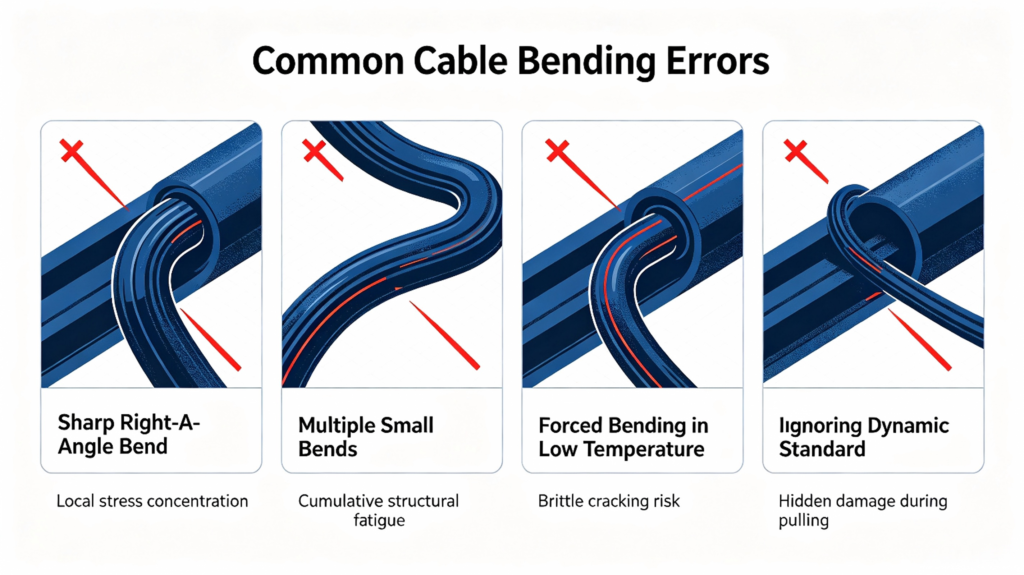
Most bending non-compliance comes from irregular on-site operation. The four most common errors in engineering are summarized as follows:
- Sharp right-angle bending: Force the cable to turn at a right angle to save space, far below the standard bending radius, causing serious internal insulation extrusion.
- Overlapping bending at multiple points: Multiple continuous small-radius bends cause cumulative structural fatigue of the cable, greatly reducing service life.
- Forced bending in low temperature: The insulation material becomes brittle in low-temperature environments. Forced bending easily causes cracking and peeling.
- Ignoring dynamic laying standards: Adopting static bending standard during cable pulling, resulting in hidden damage during construction.
5. Standardized Cable Bending & Laying Guidelines
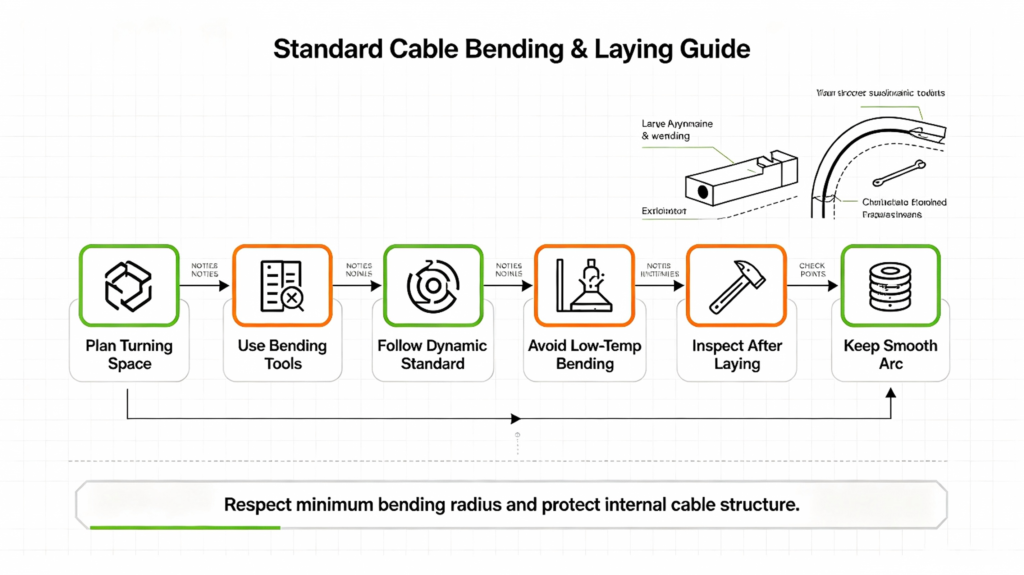
To eliminate bending hidden dangers, construction must strictly distinguish between dynamic laying and static fixing, and follow standardized operation specifications:
- Reserve sufficient turning space during pipeline and trench design to avoid forced bending of cables.
- Use professional bending auxiliary tools for large-diameter cables to control the arc uniformly without sharp corners.
- Strictly implement larger bending multiples during cable pulling and laying than static fixing standards.
- Avoid bending operation in ultra-low temperature environments; take preheating measures when necessary.
- Inspect all bending positions after laying to check for sheath deformation and ensure compliance.
FAQ About cable insulation resistance
A1: For ordinary XLPE power cables, the minimum static bending radius is 10 times the cable outer diameter, and 12 times during dynamic laying to prevent insulation extrusion damage.
A2: Right-angle bending will produce excessive local stress, causing insulation micro-cracks, conductor deformation and partial discharge, leading to premature cable aging and breakdown faults.
A3: Yes. Non-standard bending causes latent internal damage, which will gradually deteriorate during operation and may reduce cable service life by more than 40%.
7. Conclusion
Cable bending radius is a key control point in cable installation quality. Non-standard bending will cause invisible insulation damage, structural deformation and latent aging faults, seriously affecting the long-term safe operation of power lines. Strictly following minimum bending standards and standardized construction is essential to extend cable service life and reduce later maintenance costs.
If you need high-flexibility, anti-cracking power cables suitable for complex laying environments, Yidong Crosslinked Cable provides standardized cable products and professional installation technical guidance. Contact us for reliable project solutions and free product datasheets.