
Industry Data: Over 55% of hidden cable mechanical defects are caused by excessive pulling tension during laying. Over-tension stretches conductors, crack insulation, and leave latent faults that lead to premature cable failure in 2–3 years.
Cable pulling tension standard is a mandatory construction control parameter for power cable installation. In long-distance pipeline laying, trench pulling and crossing construction, uncontrolled pulling force will cause irreversible mechanical damage inside and outside the cable. Many on-site construction teams only focus on laying speed and ignore tension limits, resulting in invisible quality hazards.
As an essential construction specification matching cable bending radius standard, tension control determines the long-term operational safety of the cable. This article systematically explains cable tension calculation methods, industry limit standards, common construction damages and standardized prevention solutions to optimize cable installation quality.
1. What Is Cable Pulling Tension?
Cable pulling tension refers to the axial traction force applied to the cable during laying. Each type of power cable has a maximum allowable pulling tension defined by international standards. The tension value is determined by the cable conductor material, cross-sectional area, sheath structure and laying distance.
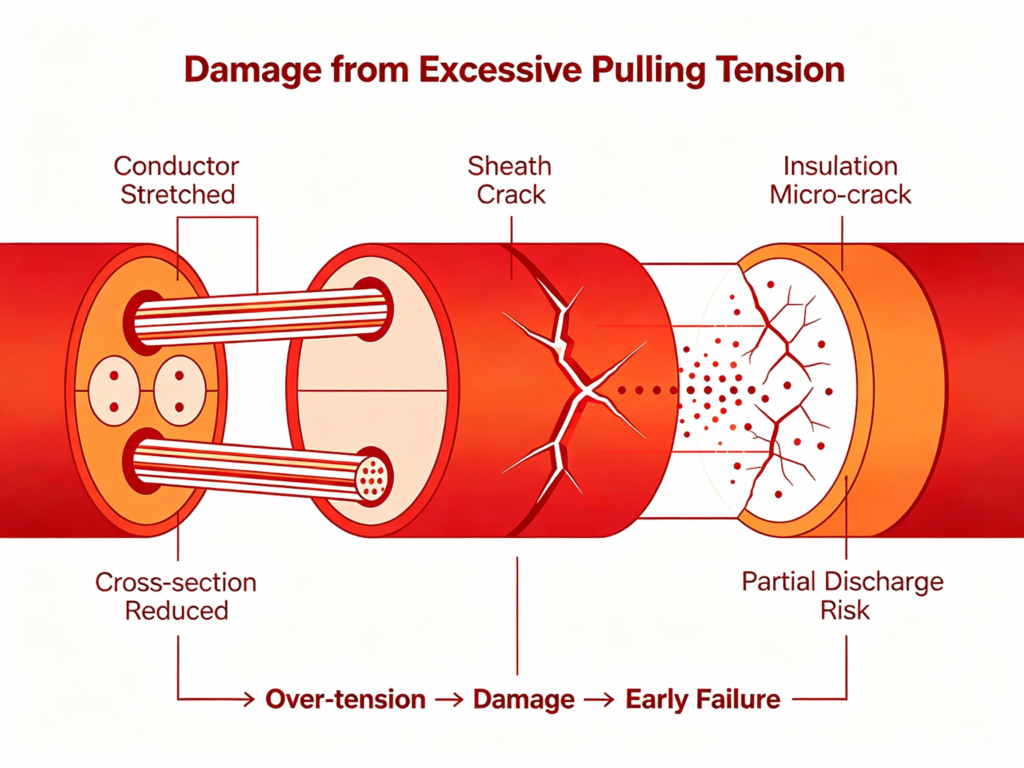
Excessive pulling tension will stretch the copper or aluminum conductor, damage the outer sheath, and produce micro-cracks in the insulation layer. Similar to non-standard bending, tension damage does not cause immediate failure but greatly shortens the cable service life and increases the risk of cable water ingress and insulation aging.
2. Universal Cable Pulling Tension Calculation & Limit Standards
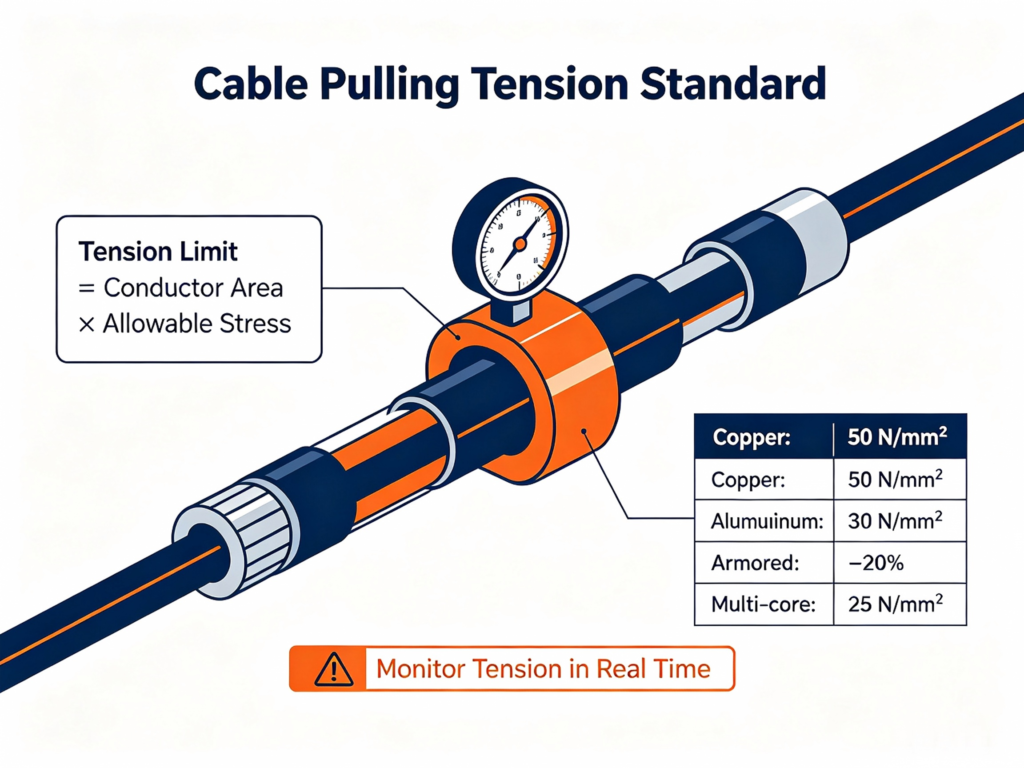
Field construction follows IEC and IEEE industry specifications. The maximum pulling tension is calculated based on conductor cross-section and material. The following table shows standard tension limits for common power cables:
| Cable Conductor Type | Maximum Allowable Tension | Calculation Basis | Construction Reminder |
| Copper conductor power cable | 50 N per mm² cross-section | Based on copper tensile strength | Strictly control long-distance traction tension |
| Aluminum conductor power cable | 30 N per mm² cross-section | Based on aluminum ductility limit | Aluminum cables are more prone to stretching deformation |
| Armored cable | Reduce 20% of standard tension | Consider rigid sheath stress | Avoid armor layer dislocation and cracking |
| Multi-core control cable | 25 N per mm² cross-section | Consider multi-strand structure stress | Prevent loose internal core wires |
3. Typical Cable Damages Caused by Excessive Pulling Tension
Core Reminder: Tension damage is latent mechanical fatigue. Damaged cables can pass routine tests but will age rapidly under long-term load operation.
- Conductor stretching and deformation: Excessive tension stretches the cable conductor, reducing cross-sectional area, increasing line resistance, and causing abnormal temperature rise and cable thermal aging.
- Outer sheath cracking and peeling: Over-traction tears the outer sheath, destroying the waterproof and protective layer, leading to moisture and dust intrusion.
- Internal insulation micro-damage: Sustained axial force causes insulation layer separation and micro-cracks, inducing partial discharge and insulation breakdown faults.
- Strand loosening and dislocation: Multi-core cables are prone to internal strand displacement, resulting in unstable cable structure and reduced mechanical durability.
4. Common On-Site Pulling Construction Errors
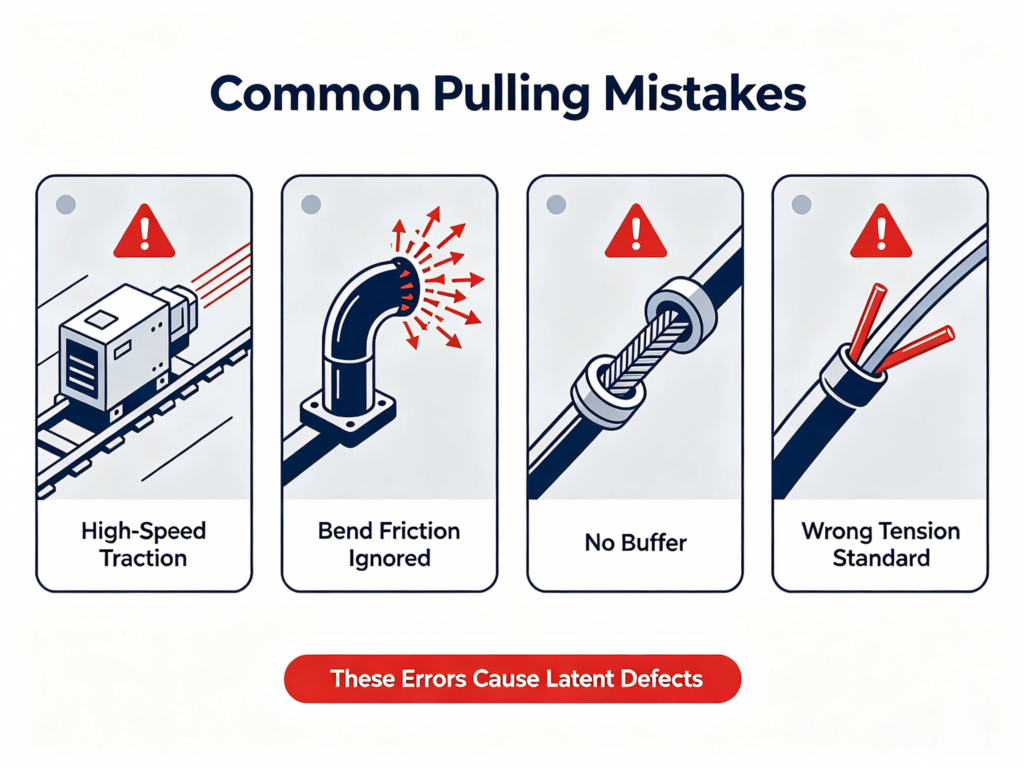
Most tension overload problems stem from irregular manual operation and unreasonable construction design:
- Blind high-speed traction: Pursue construction progress without real-time tension monitoring, resulting in instantaneous over-limit pulling force.
- Ignoring bend friction resistance: Multiple bends in the pipeline greatly increase friction tension, easily exceeding the cable bearing limit.
- No tension buffer measure: Direct hard pulling without buffer equipment causes instantaneous impact force far exceeding standard tension.
- Mixed tension standard for different cables: Apply copper cable tension standard to aluminum cables, causing permanent conductor deformation.
5. Standardized Construction Methods to Avoid Tension Damage
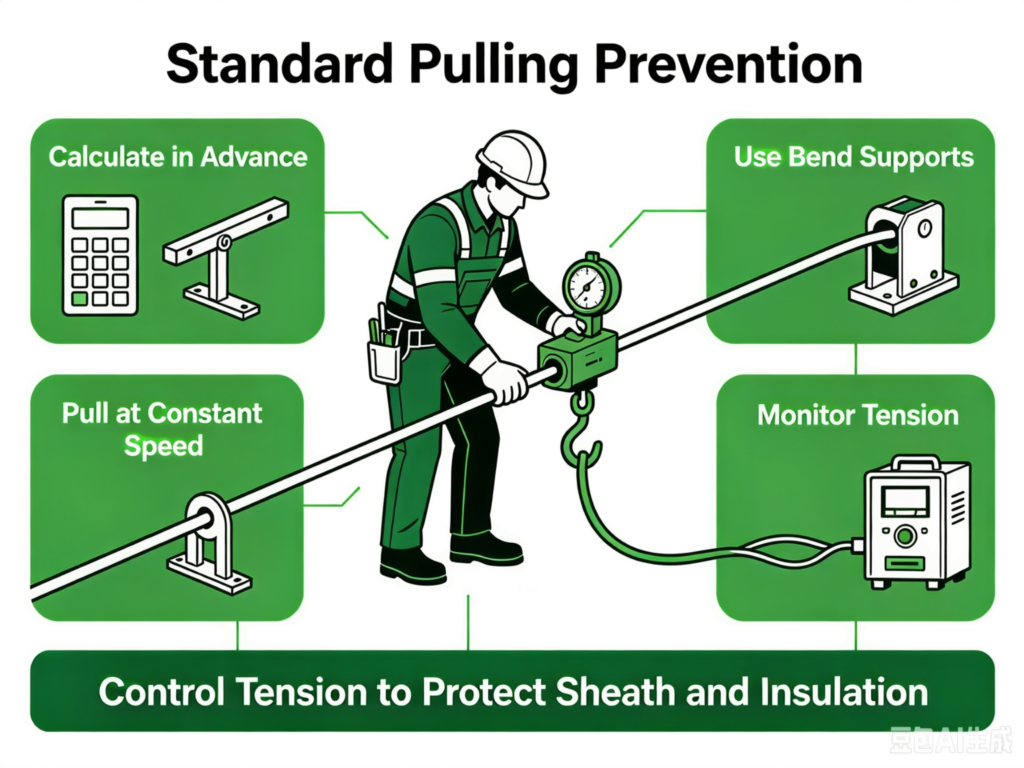
To strictly comply with cable pulling tension standard and eliminate mechanical hidden dangers, on-site construction shall implement the following standardized measures:
| Construction Link | Standard Operation Measures | Engineering Effect |
| Pre-construction calculation | Calculate maximum allowable tension according to cable material and cross-section | Set clear tension upper limit for construction |
| Bend and friction control | Lay sliding supports at bends to reduce friction resistance | Avoid cumulative tension surge at turning points |
| Constant-speed traction | Adopt low-speed uniform pulling, forbid sudden start and stop | Eliminate instantaneous impact tension |
| Real-time monitoring | Equip tension tester for long-distance cable laying | Stop operation immediately once over-limit |
6. Daily Construction Maintenance Specifications
- Classify cable types before laying and confirm matching pulling tension standards.
- Optimize pipeline bending layout to reduce excessive friction resistance.
- Use professional traction equipment and buffer tools for large-diameter cables.
- Inspect cable sheath integrity after pulling to exclude tension damage.
FAQ About cable insulation resistance
A1: The industry standard maximum pulling tension for copper power cables is 50 N per square millimeter of conductor cross-section, while aluminum cables are limited to 30 N/mm² to prevent conductor stretching.
A2: Over-limit tension causes conductor deformation, sheath cracking and insulation micro-cracks, leading to water ingress, thermal aging and premature breakdown of power cables during long-term operation.
A3: Calculate tension limit in advance, reduce bend friction with sliding supports, adopt uniform low-speed traction, and equip real-time tension monitoring instruments for standardized construction.
8. Conclusion
Cable pulling tension standard is a core guarantee for cable installation quality and long-term operational safety. Uncontrolled pulling force will bring latent mechanical damage, which will induce various cable faults and greatly reduce service life. Combined with standardized bending construction and waterproof protection, tension control can completely eliminate most installation-quality hidden dangers.
If you need high-mechanical-strength, anti-stretching power cables for long-distance pipeline and complex laying projects, Yidong Crosslinked Cable provides full-specification standard cables and professional construction technical guidance. Contact us for free technical datasheets and customized project quotations.