
Industry Practical Data: More than 65% of cable overheating and line aging faults in long-term operation are caused by mismatched conductor materials. Many projects blindly choose aluminum cables for cost savings or copper cables for full safety, resulting in either hidden operational risks or unnecessary cost waste.
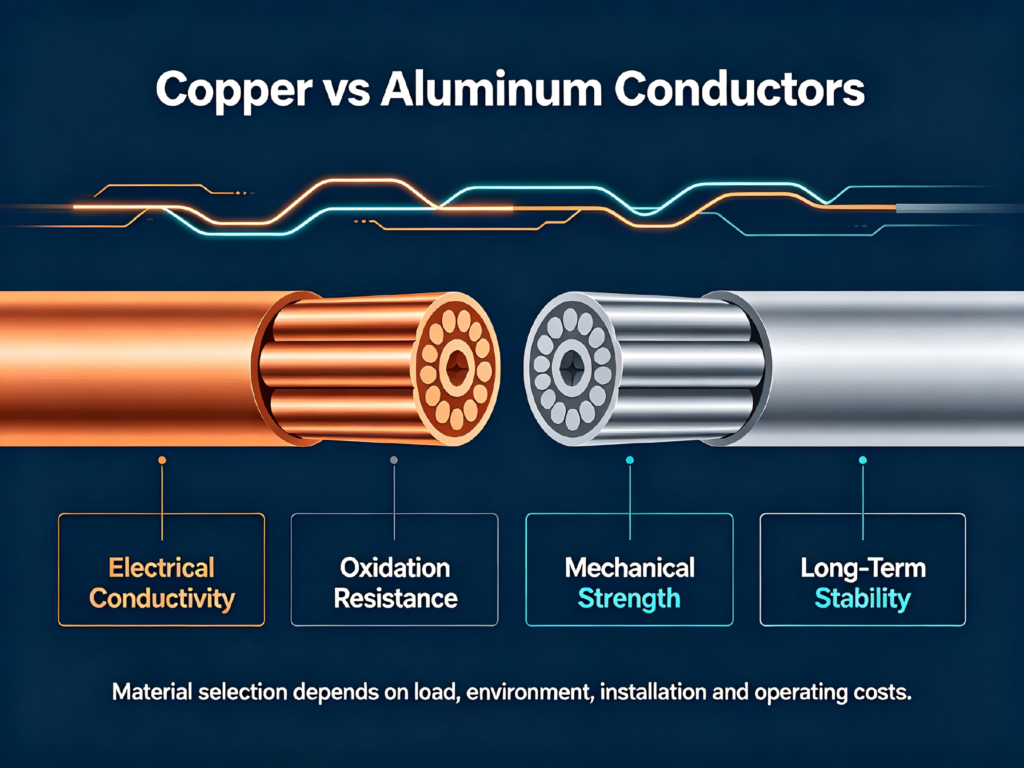
Cable conductor is the core carrier of power transmission, directly determining the cable’s current carrying capacity, operational stability, service life and overall project cost. In residential construction, industrial manufacturing, municipal power distribution and long-distance transmission projects, copper and aluminum are the two most widely used conductor materials.
Most engineering buyers and electricians only distinguish cable conductors by price, ignoring the essential differences in electrical conductivity, oxidation resistance, mechanical performance and load adaptability. This article provides a full comparison of copper and aluminum cable conductors, summarizes their respective advantages, limitations and applicable scenarios, and delivers universal and practical selection guidelines for various engineering projects.
1. Core Performance Comparison: Copper vs Aluminum Conductors
Copper and aluminum conductors have obvious differences in key performance indicators. These fundamental gaps determine their different service life and operational safety in complex power environments:
| Performance Index | Copper Conductor Cable | Aluminum Conductor Cable | Practical Difference |
| Electrical Conductivity | High conductivity, low resistance, stable power transmission efficiency | Relatively lower conductivity, higher line resistance | Aluminum cables generate more heat under the same load, with larger power loss |
| Oxidation & Corrosion Resistance | Slow oxidation rate, stable surface performance, not easy to corrode | Easy to oxidize in air, forming insulating oxide layer on the surface | Aluminum cable joints are prone to poor contact and overheating after long-term operation |
| Mechanical Toughness | High tensile strength, good flexibility, resistant to bending and stretching | Soft texture, low tensile strength, easy to break after repeated bending | Copper cables adapt to complex laying environments; aluminum cables are suitable for fixed straight laying |
| Current Carrying Stability | Stable current carrying capacity, small temperature rise under long-term full load | Current carrying capacity decays slightly with service time, obvious temperature rise under heavy load | Copper cables support long-term continuous heavy-load operation more safely |
| Service Life | Long service life, low failure rate, suitable for long-term fixed engineering | Shorter comprehensive service life, higher aging failure rate | Copper cables can reduce later maintenance and replacement costs |
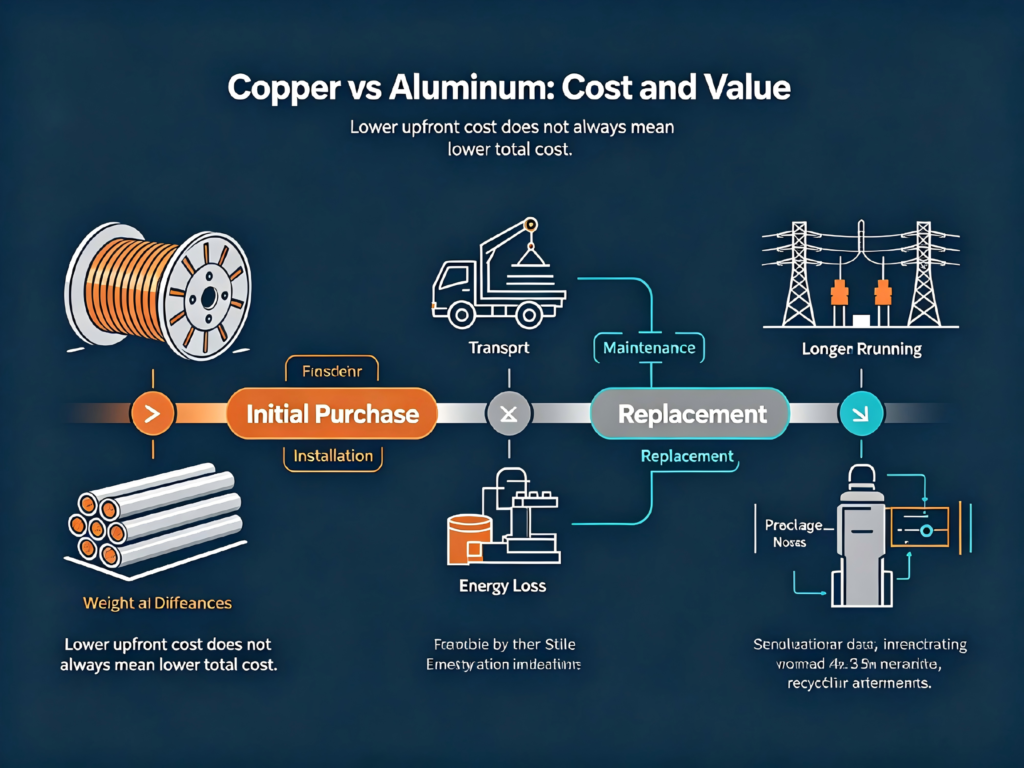
2. Cost and Economic Benefit Analysis
In engineering procurement, cost is a key factor for conductor selection. Although aluminum cables have lower unit material cost, the comprehensive economic benefits vary greatly in different scenarios due to performance limitations:
- Initial procurement cost: Aluminum cables have obvious price advantages. Under the same conductor cross-section, aluminum cable cost is about 30%–40% lower than copper cable, which can effectively reduce the short-term investment of the project.
- Construction cost: Aluminum cables are light in weight, easy to transport and lay, saving construction labor and machinery costs for long-distance large-scale laying. Copper cables are heavy and require higher construction technical requirements.
- Operation and maintenance cost: Copper cables have stable performance, low line loss and almost no joint failure maintenance. Aluminum cables have large line loss and frequent joint overheating problems in later operation, requiring regular inspection and maintenance, increasing long-term operating expenses.
- Replacement cost: Aluminum cables age faster and need to be replaced periodically in high-load and long-term operation scenarios, while copper cables can maintain stable operation for decades without replacement.
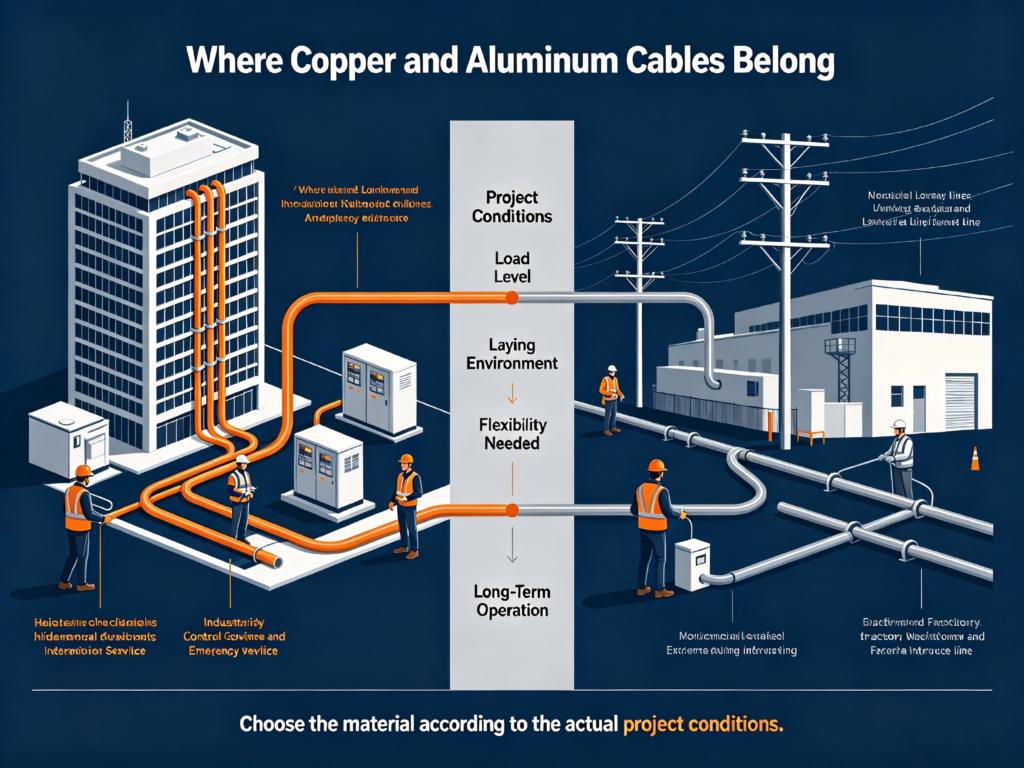
3. Typical Application Scenarios of Copper and Aluminum Cables
Combined with performance and economic characteristics, copper and aluminum conductor cables have their own exclusive applicable scenarios. Reasonable matching can balance safety and cost to the greatest extent:
| Cable Conductor Type | Core Advantages | Priority Application Scenarios | Not Recommended Scenarios |
| Copper Conductor Cable | Safe and stable, low loss, anti-aging, flexible and durable | High-rise buildings, residential indoor wiring, precision equipment power supply, industrial control circuits, emergency power loops, densely laid cables, long-term uninterrupted operation projects | Ultra-long distance low-voltage transmission projects with strict cost control |
| Aluminum Conductor Cable | Low price, light weight, cost-effective for large laying volume | Outdoor overhead transmission lines, municipal low-voltage trunk lines, factory external power introduction, large-scale open laying low-load lines | Indoor dense wiring, equipment flexible connection, emergency power supply loop, high-precision power supply scenarios |
4. Common Selection Mistakes in Engineering
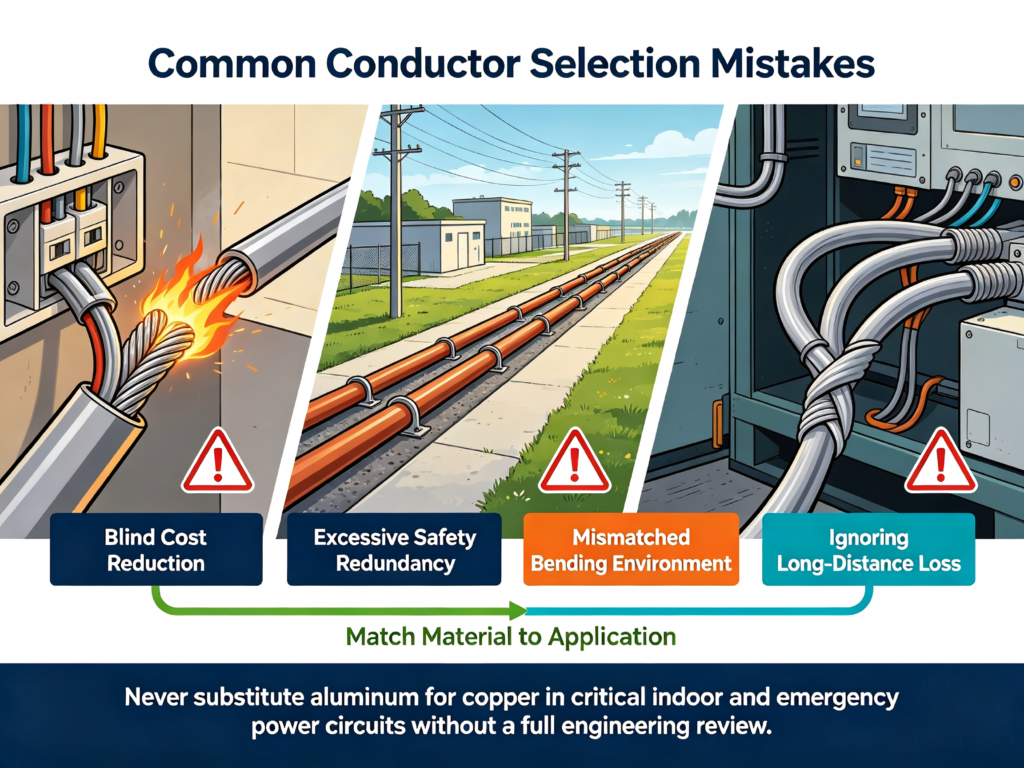
Core Selection Taboo: Never use aluminum cables instead of copper cables for indoor terminal wiring and emergency power circuits. The unstable contact performance of aluminum conductors will easily cause overheating and power failure accidents, threatening operational safety.
- Blind cost reduction: Many medium and small projects replace all copper cables with aluminum cables to save costs, ignoring the hidden dangers of aluminum cable aging and joint overheating in indoor and high-load scenarios.
- Excessive safety redundancy: Using high-cost copper cables for outdoor overhead long-distance low-load lines causes serious cost waste without improving actual operational safety.
- Mismatched wiring environment: Aluminum cables are used for frequently bent and moved equipment connecting lines, which are easy to break and cause line faults.
- Ignoring line loss difference: Long-distance low-voltage transmission with aluminum cables will produce large power loss, increasing long-term power consumption costs far exceeding the saved cable purchase cost.
5. Conclusion
Copper and aluminum conductor cables have no absolute distinction between good and bad, only scenario adaptation differences. Copper cables dominate in safety, stability and service life, suitable for indoor wiring, high-load operation and key power guarantee scenarios. Aluminum cables have outstanding economic advantages, ideal for outdoor overhead, long-distance trunk lines and low-load large-scale laying projects.
Scientific selection of cable conductor materials according to laying environment, load demand and project service life can effectively avoid operational faults, balance project investment and long-term operation benefits, and realize the most reasonable cable engineering configuration.
FAQ About cable insulation resistance
Copper has higher conductivity, lower resistance and better oxidation resistance. Aluminum is lighter in weight but features higher resistivity and larger voltage drop.
Select copper cables for indoor wiring, commercial buildings and safety-sensitive projects. Aluminum cables are ideal for long-distance overhead power transmission.
Aluminum cables have lower upfront material cost. Copper cables cost more initially but bring lower power loss and longer service life for long-term projects.
There is no absolute “better” choice between copper and aluminum cables. The right decision depends on your project distance, current load, budget and installation environment. Copper wins on conductivity, stability and safety for indoor and high-demand applications, while aluminum delivers strong lightweight and cost advantages for long-distance overhead transmission.
If you need professional conductor selection advice for your project, Yidong Crosslinked Cable can supply both copper and aluminum power cables with full technical specifications. Contact our engineering team for customized solutions and competitive quotations.