
Industry Data: More than 75% of hidden cable faults and sudden power outages in long-term operating projects are caused by gradual insulation aging, rather than sudden mechanical damage. Insulation aging is the most invisible and dangerous potential risk in power system operation.
Cable insulation is the core protective layer that isolates current, prevents leakage and ensures electrical safety. Like all polymer materials, cable insulation will gradually age after long-term operation. Aging will lead to decreased insulation performance, increased leakage current, and even cause short circuits, electric leakage and cable breakdown in severe cases.
Many engineering teams only replace cables after obvious faults occur, ignoring early aging signs. This article summarizes the universal aging mechanisms, typical classification symptoms, and practical maintenance optimization methods, helping enterprises reduce cable failure rate and extend the overall service life of power lines.
1. Main Causes of Cable Insulation Aging
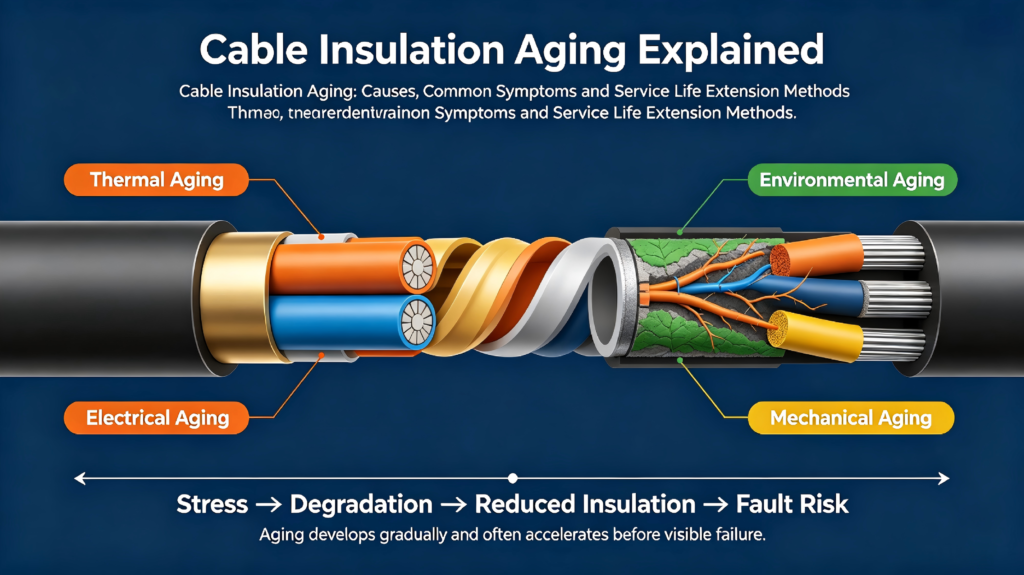
Insulation aging is a comprehensive slow failure process affected by temperature, environment, electricity and mechanical stress. The core aging factors in daily operation are summarized as follows:
- Thermal Aging: Long-term overloading and poor heat dissipation keep the cable working at high temperature continuously. The internal polymer insulation material will gradually decompose and harden, resulting in reduced toughness and decreased insulation strength. Thermal aging is the primary cause of most cable life attenuation.
- Electrical Aging: Long-term exposure to electric field stress, frequent voltage fluctuations and partial discharge will erode the insulation layer internally. Micro-cracks and electric tree structures will appear inside the insulation, slowly expanding and eventually causing insulation breakdown.
- Environmental Aging: Outdoor cables and workshop cables are affected by humidity, oxygen, ultraviolet rays and chemical corrosion. Long-term moisture penetration and oxidation will make the insulation layer brittle, delaminated and mildewed, greatly reducing insulation performance.
- Mechanical Aging: Extrusion, stretching, bending and vibration during laying and operation will cause internal fatigue damage to the insulation. Long-term mechanical stress will produce tiny cracks, which gradually expand and accelerate aging failure.
2. Aging Characteristics of Common Cable Insulation Materials
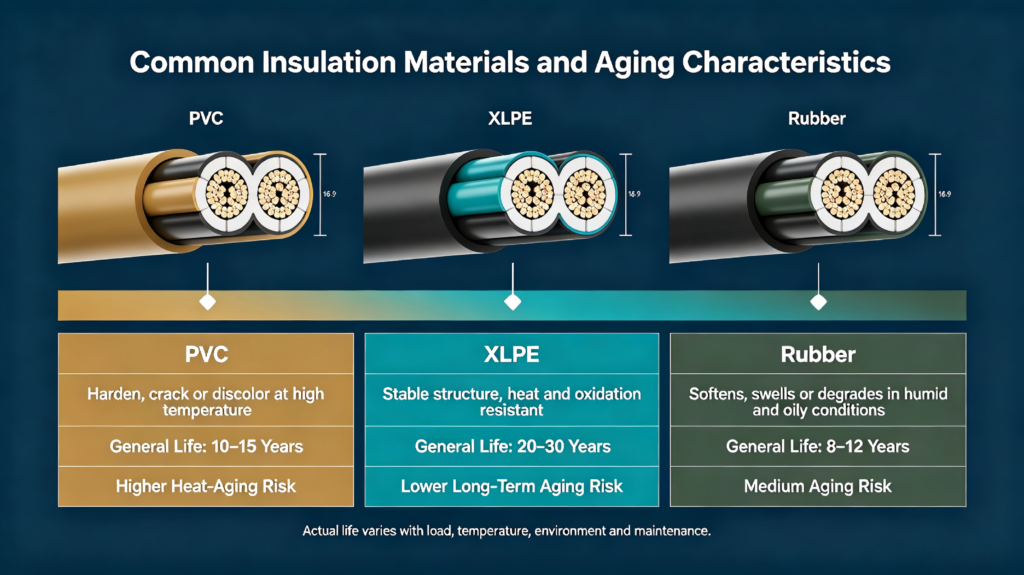
Different insulation materials have different aging speeds and failure characteristics under the same operating environment. Understanding material differences helps judge aging risks and formulate replacement cycles:
| Insulation Material | Main Aging Features | General Service Life | Aging Risk Level |
| PVC Insulation | Easy to harden, crack and turn yellow at high temperature; poor anti-aging performance | 10–15 years | High risk, easy to age in heat environment |
| XLPE Crosslinked Insulation | Stable structure, heat-resistant and oxidation-resistant, slow aging speed | 20–30 years | Low risk, suitable for long-term operation |
| Rubber Insulation | Easy to soften, swell and age in humid and oily environment | 8–12 years | Medium risk, suitable for flexible short-term wiring |
3. Typical Aging Symptoms and Hidden Dangers
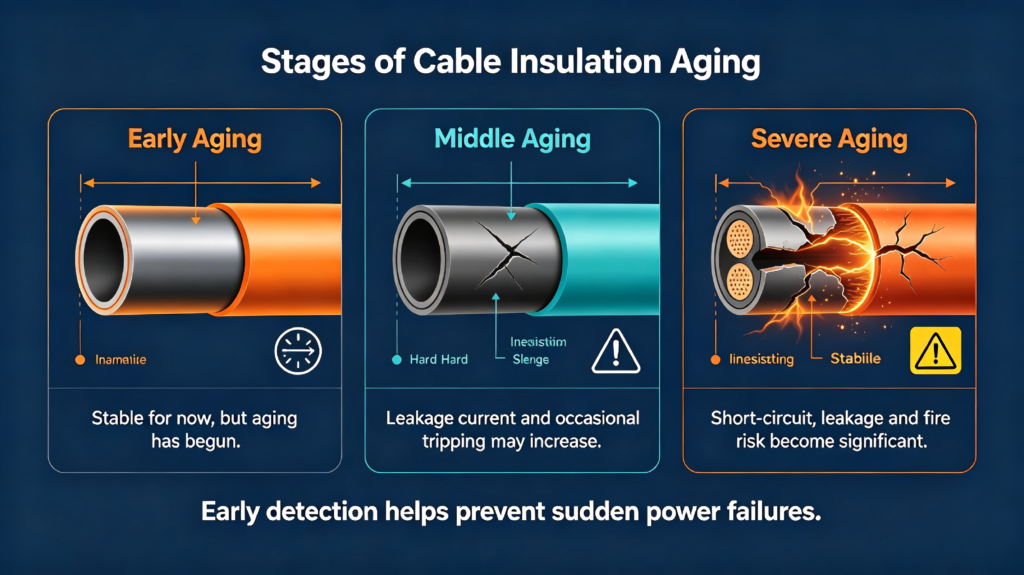
| Aging Stage | Visible & Testable Symptoms | Potential Hidden Danger |
| Early Aging | Slight discoloration of outer sheath, reduced surface gloss, stable insulation resistance | No immediate risk, but enters the aging acceleration cycle |
| Medium Aging | Insulation hardening, local fine cracks, decreased insulation resistance, slight line temperature rise | Leakage current increases, prone to occasional tripping |
| Severe Aging | Insulation peeling, obvious cracking, exposed inner layer, unstable resistance value, serious heating | Easy short circuit, electric leakage and cable fire accidents |
Core Reminder: Most cable premature aging is not caused by material quality, but by irregular laying and long-term overload operation. Standard use is the most effective way to extend cable life.
- Dense laying without heat dissipation space: Cables stacked in multiple layers and closed trays accumulate heat for a long time, resulting in accelerated aging attenuation.
- Excessive bending and extrusion during construction: Unstandard construction causes internal insulation damage, forming latent aging defects.
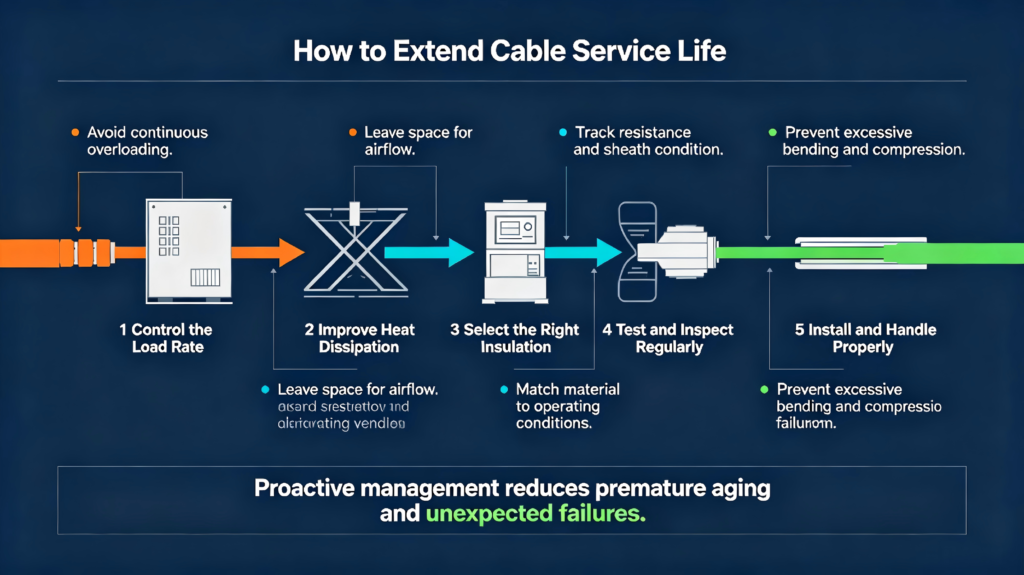
4. Practical Methods to Extend Cable Service Life
- Optimize laying heat dissipation conditions: Reserve gaps for densely laid cables, avoid fully closed stacking, and ensure air convection and heat dissipation.
- Regular insulation detection and maintenance: Regularly test cable insulation resistance, check sheath aging and damage, and replace aging cables in advance.
6. Conclusion
Hunan Yidong Crosslinked Cable provides high-quality XLPE insulated, anti-aging, waterproof and corrosion-resistant power cables. The products feature stable insulation performance and strong environmental adaptability, effectively delaying insulation aging and ensuring long-term safe and stable operation of engineering lines.
If you have project requirements, contact Yidong Crosslinked Cable for technical support and quotation.
FAQ About cable insulation resistance
Under normal installation and operating conditions, high-quality XLPE power cables can reach a service life of 25 to 30 years. Improper use will greatly shorten the lifespan.
Minor surface damage can be handled with insulation repair sleeves. If the main insulation layer is aged or cracked, replacement is the only safe solution. Repair is not reliable for high-voltage power cables.
Insulation aging is a slow, long-term degradation. Overload damage causes rapid thermal decomposition of insulation, which can directly trigger sudden cable short circuit.