
Industry Data: According to power engineering fire safety statistics, more than 70% of cable fire spread accidents in building and industrial projects are caused by improper flame retardant grade selection, rather than inherent cable quality problems. Ordinary non-flame-retardant cables are extremely flammable when short-circuited, and will accelerate fire spread along wiring routes, causing large-area linked fire hazards.
Flame retardant performance is one of the most critical safety indicators for power cables in building electrical systems, industrial workshops, municipal pipe galleries and power distribution projects. Many engineering staff confuse the definitions of Class A, B and C flame retardant grades, leading to two common problems: excessive cable specification upgrade that wastes project costs, or insufficient fire resistance grades that leave serious potential safety hazards.
This article systematically sorts out the core differences of common flame retardant grades, cable fire resistance principles, smoke and toxicity characteristics, and practical engineering selection taboos, providing universal and practical guidance for cable fire safety design and matching.
1. Definition and Core Differences of Cable Flame Retardant Grades
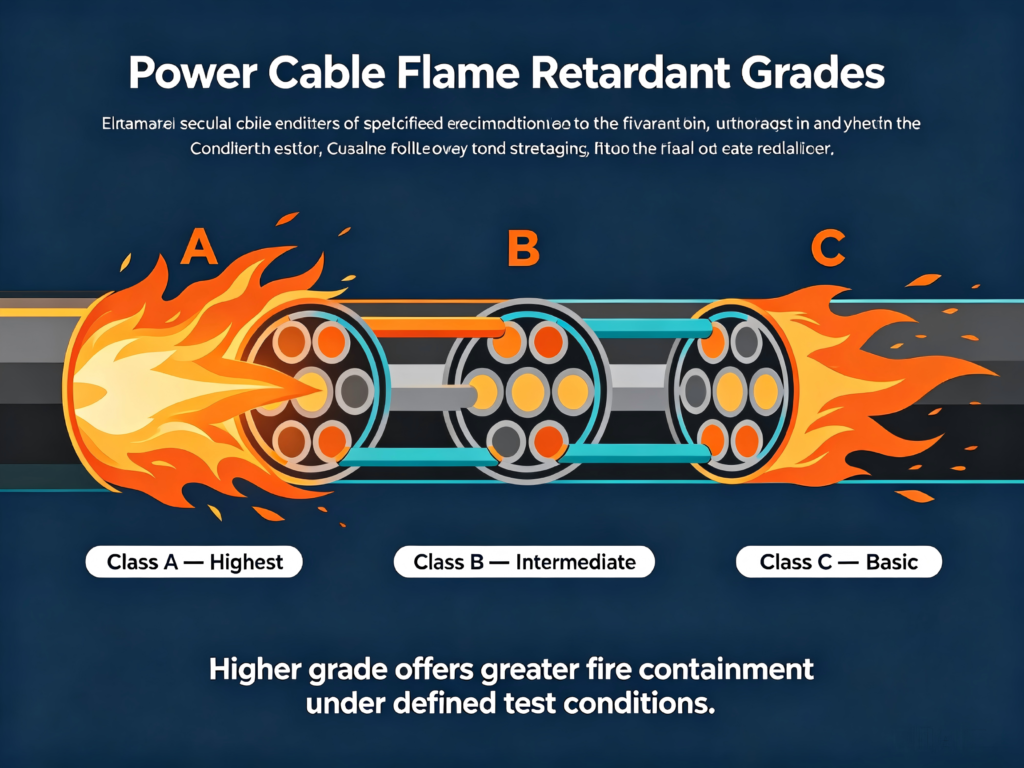
Power cable flame retardant grades are universally divided into Class A, Class B and Class C, with fire resistance decreasing in turn. The three grades differ greatly in fire resistance duration, tolerable laying quantity and flame spread range, serving as the basic reference for engineering design and project selection.
| Flame Retardant Grade | Fire Resistance Duration | Test Laying Quantity | Fire Spread & Self-Extinguishing Performance | Applicable Scenarios |
| Flame Retardant Class A (ZA) | 40 minutes (bundled combustion) | 7–12 bundled cables (large-scale dense laying) | Top-tier flame retardant performance; no continuous flame spread after removing the fire source, no residual burning, and no molten dripping that ignites surrounding combustibles. It can suppress fire spread in dense cable laying scenarios. | Ultra-high fire risk scenarios: urban comprehensive pipe galleries, underground cable corridors, high-rise building main power trunk lines, petrochemical and chemical plant production areas |
| Flame Retardant Class B (ZB) | 40 minutes (bundled combustion) | 4–6 bundled cables (conventional dense laying) | Reliable self-extinguishing performance, limited flame spread range, no secondary ignition of molten material, suitable for most dense laying engineering scenarios | High fire risk scenarios: industrial factory workshops, large shopping malls, office buildings, hospital public area power distribution lines |
| Flame Retardant Class C (ZC) | 20 minutes (single cable combustion) | 1–2 single cables (sparse single laying) | Basic self-extinguishing capability, only applicable to single sparse laying. Poor fire resistance for dense bundled laying, prone to fire spread | Low fire risk scenarios: ordinary residential indoor lighting circuits, low-power branch lines, open and sparse laying environments |
2. Flame Retardant Mechanism of Power Cables
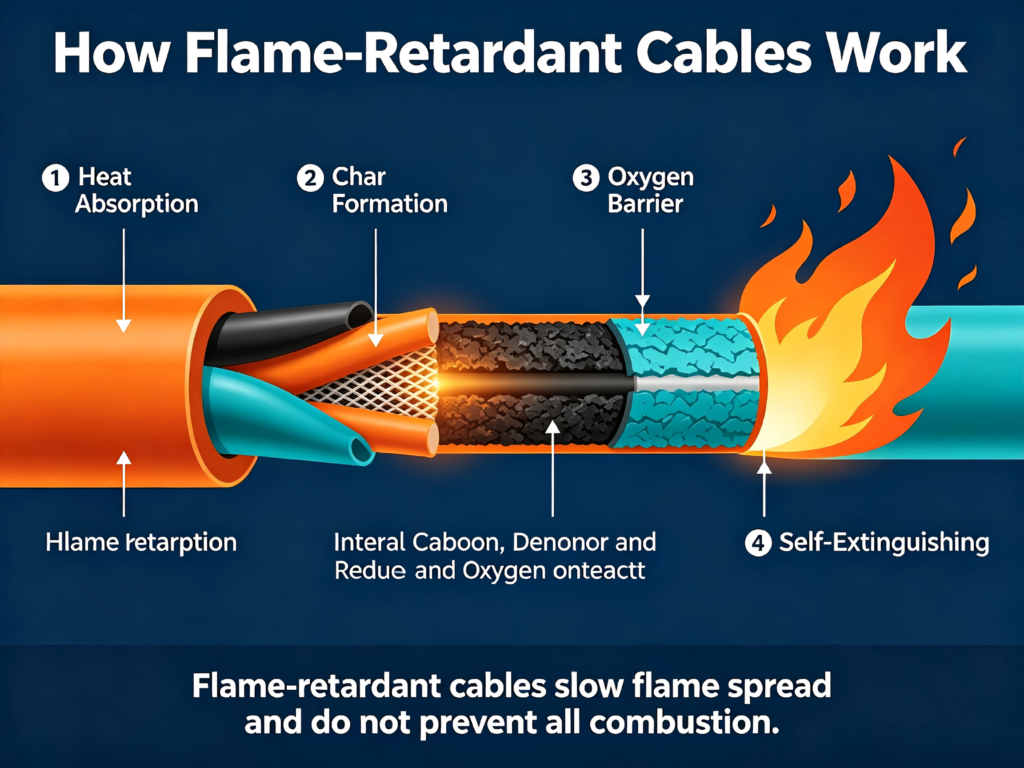
Flame-retardant cables are not non-combustible. They adopt special polymer sheath materials to form protective effects of heat absorption, temperature reduction and oxygen isolation, effectively blocking fire spread and suppressing combustion.
- Heat absorption and temperature reduction: The special flame retardant materials decompose and absorb massive heat under high temperature, lower the cable surface temperature, and restrain thermal decomposition and combustion.
- Oxygen isolation carbon layer: A dense carbonized protective layer forms on the cable surface after high-temperature combustion, isolating air contact and cutting off combustion conditions.
- Combustion suppression: Internal flame retardant ingredients capture active combustion free radicals, terminate combustion chain reactions, and enable rapid self-extinguishing after leaving the fire source.
- Anti-molten dripping: High-grade flame retardant cables avoid high-temperature molten material dripping, eliminating secondary fire hazards caused by dripping ignition.
3. Low Smoke Zero Halogen (LSZH) Flame Retardant Performance
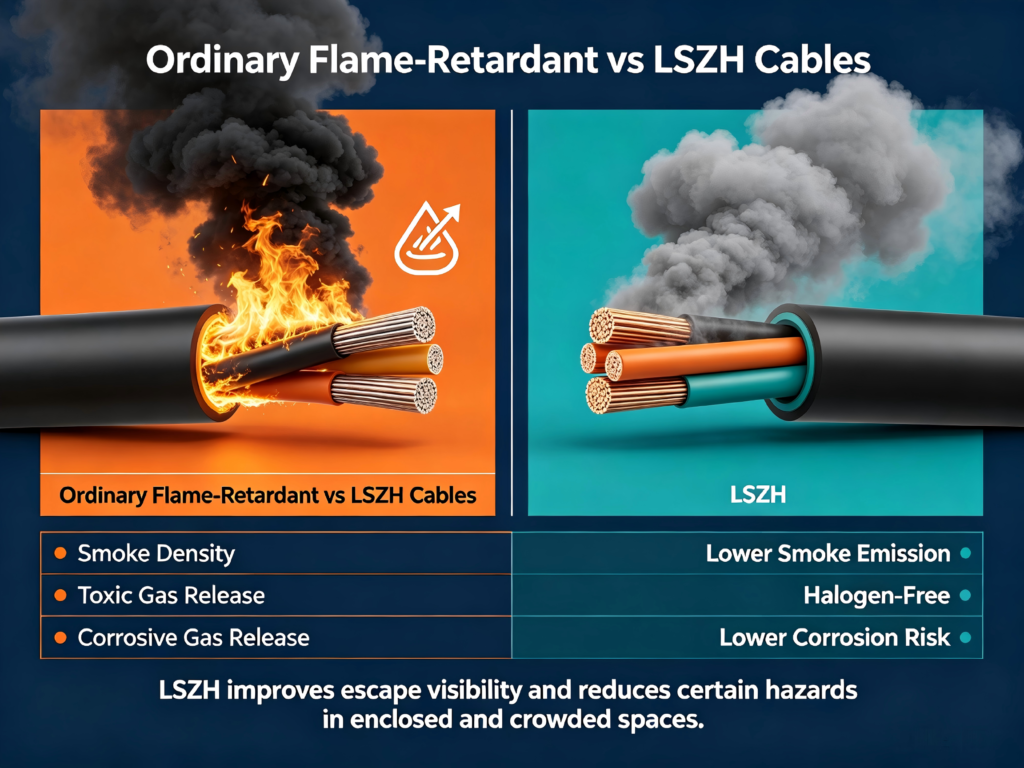
For high-standard fire protection projects, ordinary flame retardant cables are usually upgraded to low smoke zero halogen flame retardant cables. The two types have obvious performance differences, which directly affect personnel escape and fire rescue efficiency in case of fire.
| Performance Index | Ordinary Flame Retardant Cable | Low Smoke Zero Halogen Cable | Safety Advantage |
| Smoke Density | High smoke output, poor visibility after combustion | Extremely low smoke output, clear field of vision | Guarantee smooth personnel evacuation and fire rescue |
| Toxic Gas Release | Produce toxic and harmful halogen gas | No toxic and corrosive gas release | Avoid personnel poisoning and respiratory injury |
| Corrosiveness | Strong corrosive gas damages circuit equipment | No corrosive substances generated | Effectively protect secondary circuits and electrical equipment |
4. Common Engineering Selection Mistakes & Taboos
Core Taboo: Flame retardant grades cannot be arbitrarily downgraded for dense laying. Class C flame retardant cables are only suitable for single sparse laying and are strictly prohibited for dense bundled laying, main power supply lines of public buildings and pipe gallery projects, which will cause fire spread risks and fail fire safety inspection.
- Confusing flame retardant and fire-resistant cables: Flame retardant cables prevent fire spread, while fire-resistant cables can maintain normal power supply for a certain period in fire conditions. The two have different core functions and cannot replace each other.
- Low-grade cables for dense laying: Dense bundled cable laying will accumulate heat rapidly and accelerate fire spread. Class C cables fail to resist fire spread under dense laying conditions. Bridge dense laying, trunk lines and centralized wiring areas must adopt Class A or B flame retardant cables.
- Ignoring smoke and toxicity indicators: Underground spaces, shopping malls and high-rise buildings require low smoke zero halogen cables to prevent personnel suffocation caused by dense smoke in fires.
- False grade labeling: Some ordinary flame retardant products are falsely labeled as high-grade flame retardant cables. It is necessary to distinguish product grades clearly in engineering procurement.
5. Scenario-Based Flame Retardant Selection Rules
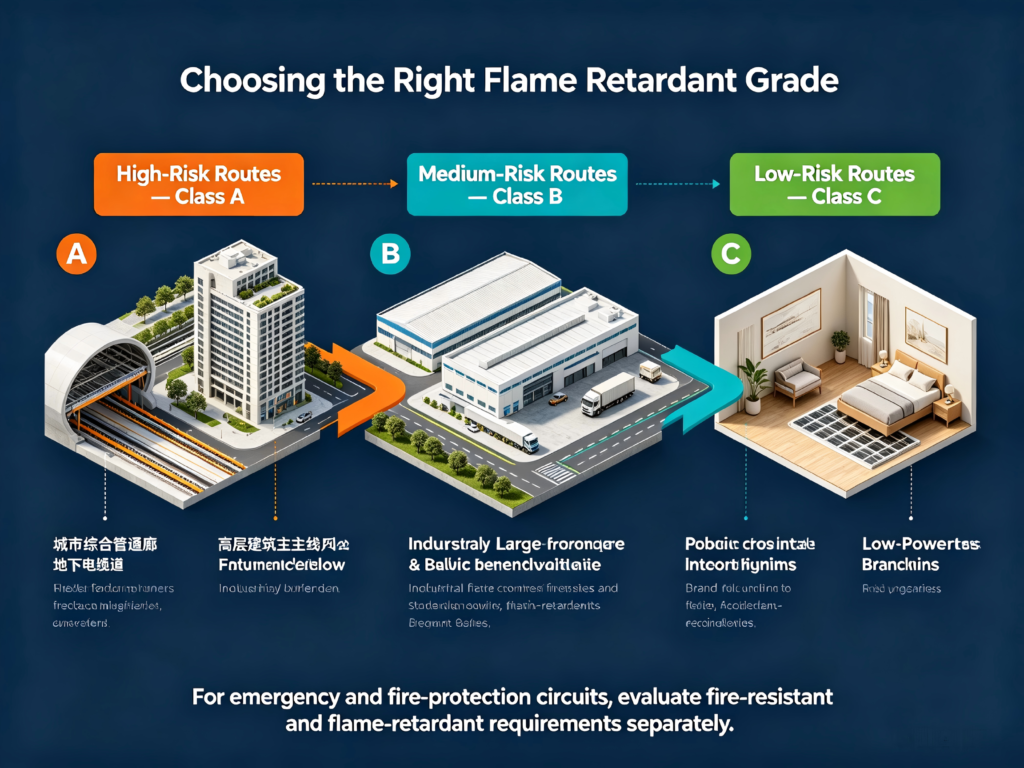
ZA Class A Flame Retardant + LSZH: Suitable for ultra-high fire risk and closed public spaces: urban comprehensive pipe galleries, subways, tunnel engineering, petrochemical explosion-proof areas, high-rise building main power lines, key public facilities and underground enclosed spaces.
| Cable Type | Applicable Fire Risk Level | Typical Engineering Application Scenarios |
| ZA Class A Flame Retardant + LSZH | Ultra-high fire risk, closed spaces | Urban comprehensive pipe galleries, subways, tunnel engineering, petrochemical explosion-proof areas, high-rise building main power lines, key public facilities and underground enclosed spaces |
| ZB Class B Flame Retardant | Medium fire risk, conventional dense laying spaces | Factory production workshops, large commercial supermarkets, office buildings, hospital non-core power distribution lines and conventional dense wiring areas |
| ZC Class C Flame Retardant | Low fire risk, open and sparse laying spaces | Ordinary residential indoor lighting, small-power branch circuits, open-air wiring and non-centralized low-load lines |
| Fire-resistant & flame retardant composite cable | Special fire-fighting mandatory scenarios | Fire-fighting dedicated power lines, emergency lighting loops, safety monitoring and uninterruptible power supply circuits, ensuring continuous power supply during fire accidents |
ZB Class B Flame Retardant: Suitable for medium fire risk public and industrial spaces: factory production workshops, large commercial supermarkets, office buildings, hospital non-core power distribution lines and conventional dense wiring areas.
ZC Class C Flame Retardant: Only suitable for low fire risk, open and sparse laying scenarios: ordinary residential indoor lighting, small-power branch circuits, open-air wiring and non-centralized low-load lines.
Fire-resistant & flame retardant composite cable: Exclusive mandatory use for fire-fighting dedicated power lines, emergency lighting loops, safety monitoring and uninterruptible power supply circuits, ensuring continuous power supply and fire resistance during fire accidents.
6. Conclusion
Flame retardant grade is the core safety basis for cable fire protection design. There are clear performance gaps between Class A, B and C cables, especially in dense laying fire resistance. Correct grade selection based on actual laying density and fire risk can effectively avoid cable fire spread accidents, balance engineering cost and safety performance, and meet daily operation and fire safety requirements.
Hunan Yidong Crosslinked Cable provides full-series Class A/B/C flame retardant and low-smoke zero-halogen cables, covering all low, medium and high-risk engineering scenarios. All products adopt mature flame retardant formulas, with stable fire resistance, effectively preventing cable fire spread and improving the overall fire safety level of power systems.
Official Website: https://yidongjiaolian.com