
Choosing the right insulation material is one of the most important decisions when selecting a power cable. The insulation layer directly affects cable performance, safety, service life and reliability.
Among various cable insulation materials, XLPE (Cross-linked Polyethylene) and PVC (Polyvinyl Chloride) are two of the most commonly used options.
Both types of cables have their own advantages and are widely applied in power distribution, construction, industrial facilities and infrastructure projects.
This article explains the key differences between XLPE cables and PVC cables to help engineers, contractors and buyers select the most suitable cable solution.
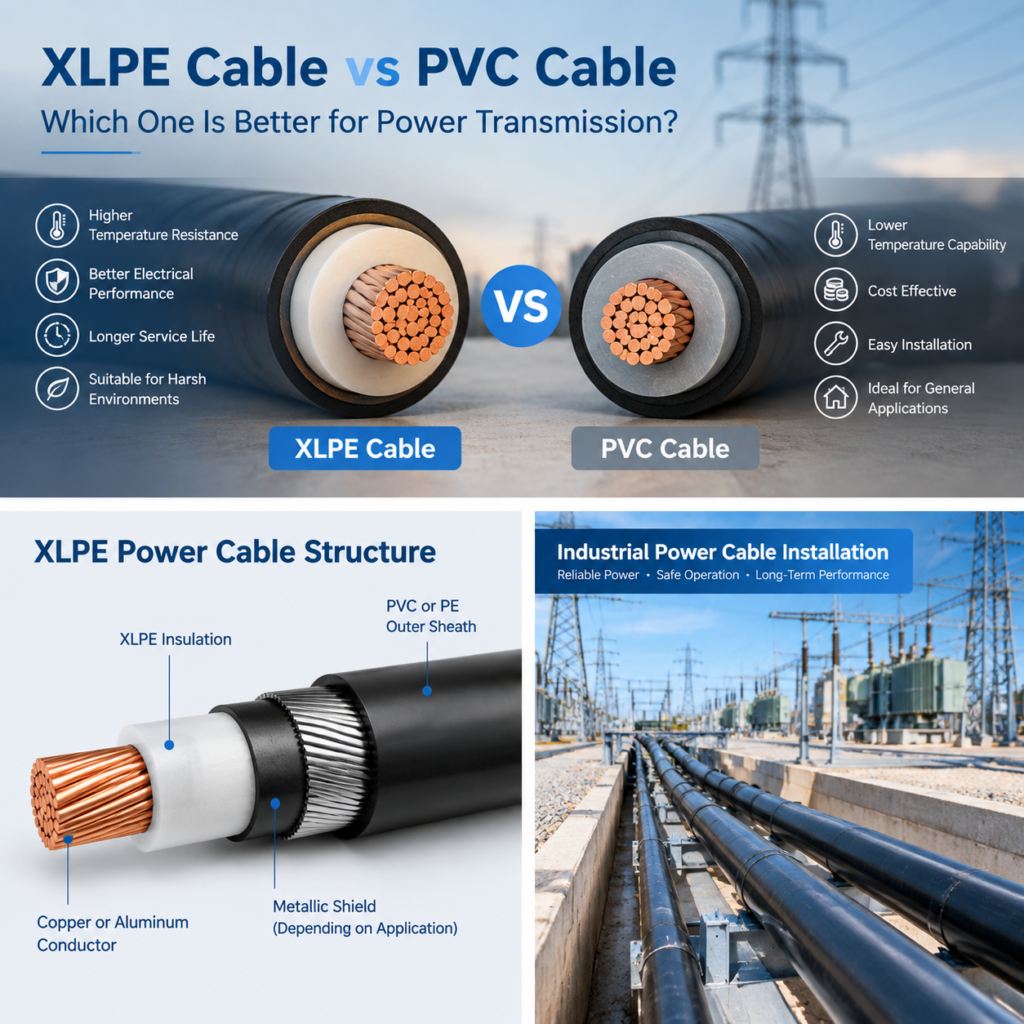
- What Is XLPE Cable?
XLPE cable refers to a power cable that uses cross-linked polyethylene as the insulation material.
Through a cross-linking process, polyethylene obtains improved thermal and electrical properties compared with traditional insulation materials.
Typical XLPE cable structures include:
- Copper or aluminum conductor
- XLPE insulation
- Metallic shielding (depending on application)
- PVC or PE outer sheath
XLPE insulated cables are widely used in: - Medium voltage power distribution
- Industrial power systems
- Renewable energy projects
- Underground power networks
- What Is PVC Cable?
PVC cable uses polyvinyl chloride as the insulation material.
PVC is one of the most widely used cable insulation materials because it provides good electrical protection while maintaining cost efficiency.
Typical PVC cable applications include:
- Building wiring
- Low voltage power distribution
- Electrical equipment connections
- General commercial applications
PVC insulated cables are commonly selected for projects where cost-effectiveness and easy installation are important factors.
- XLPE Cable vs PVC Cable: Key Differences
3.1 Temperature Resistance
Temperature capability is one of the biggest differences between XLPE and PVC insulation.
XLPE Cable:
- Higher operating temperature
- Better heat resistance
- Suitable for higher load conditions
XLPE insulated cables typically support higher continuous conductor temperatures, making them suitable for demanding power systems.
PVC Cable: - Lower temperature capability
- Suitable for standard applications
For projects with high electrical loads or harsh environments, XLPE cable is usually preferred.
3.2 Electrical Performance
XLPE provides excellent electrical properties, including: - Lower dielectric loss
- Better insulation performance
- Higher resistance to electrical stress
PVC cables provide reliable insulation performance for general low voltage applications but may not perform as well as XLPE under demanding conditions.
3.3 Mechanical and Environmental Performance
Cable installation environments can vary significantly.
XLPE cables offer: - Better moisture resistance
- Better aging resistance
- Longer service life
PVC cables provide: - Good flexibility
- Easy installation
- Cost advantages
For underground, industrial or outdoor applications, XLPE cables often provide better long-term reliability.
3.4 Cost Comparison
Cost is an important factor in cable selection.
PVC cables generally have: - Lower material cost
- Lower initial investment
XLPE cables usually have: - Higher manufacturing cost
- Better long-term performance
Although XLPE cables may have a higher initial price, their longer service life and improved performance can reduce maintenance costs over time.
- Applications Comparison
Application Recommended Cable
Residential wiring PVC cable
Commercial buildings PVC / XLPE cable
Industrial power distribution XLPE cable
Underground power transmission XLPE armored cable
Renewable energy projects XLPE cable - Which Cable Should You Choose?
The choice between XLPE cable and PVC cable depends on:
Voltage Level
Higher voltage systems generally require cables with better insulation performance.
Installation Environment
Underground, outdoor and industrial environments often require stronger protection.
Project Budget
PVC cables can be suitable for cost-sensitive applications, while XLPE cables provide better long-term performance.
Required Standards
International projects may require compliance with standards such as IEC, BS, ASTM or UL. - Why Choose a Professional Cable Manufacturer?
A reliable cable supplier can help customers select the correct cable structure according to:
- Voltage requirements
- Installation conditions
- Applicable standards
- Project specifications
Professional manufacturers also provide: - Customized cable solutions
- Quality inspection
- Technical support
- Stable production capacity
Choosing an experienced power cable manufacturer helps reduce procurement risks and ensures consistent product quality.
Conclusion
Both XLPE cables and PVC cables have important roles in electrical systems.
PVC cables are suitable for general applications where cost efficiency and easy installation are priorities.
XLPE cables provide better thermal performance, electrical reliability and durability, making them ideal for industrial projects, power transmission systems and demanding environments.
Selecting the right cable insulation type ensures safer operation and better long-term value.
Frequently Asked Questions About XLPE and PVC Cable
- Is XLPE cable better than PVC cable?
XLPE cable generally provides better temperature resistance, electrical performance and service life. However, PVC cable remains a practical choice for many standard applications. - Are XLPE cables suitable for underground installation?
Yes. XLPE cables are widely used for underground power transmission because of their excellent insulation performance and durability. - Why are PVC cables commonly used in buildings?
PVC cables are popular in buildings because they are cost-effective, easy to install and provide reliable electrical insulation. - Which cable is better for industrial applications?
For industrial applications with high loads and demanding environments, XLPE insulated cables are usually preferred due to their higher performance and durability. - Can cable manufacturers customize XLPE and PVC cables?
Yes. Professional manufacturers can customize conductor materials, cable sizes, voltage ratings, insulation materials and packaging according to project requirements.
Request a Cable Solution
Looking for reliable XLPE cables or PVC cables for your project?
We provide customized power cable and building wire solutions for global customers.
Contact us today for technical support and quotation.