
The heating cycle test (often referred to as the thermal load cycle test) is a key type test for extruded-insulation power cables. It is specified under three separate IEC standards by voltage class: IEC 60502-2 for medium voltage cables from 6 kV to 30 kV, IEC 60840 for high voltage cables above 30 kV up to 150 kV, and IEC 62067 for extra-high voltage cables above 150 kV up to 500 kV. The test reproduces repeated heating and cooling cycles under real service load conditions and helps reveal insulation delamination, interface gaps and defects that may grow into partial discharge in buried and tunnel cables.
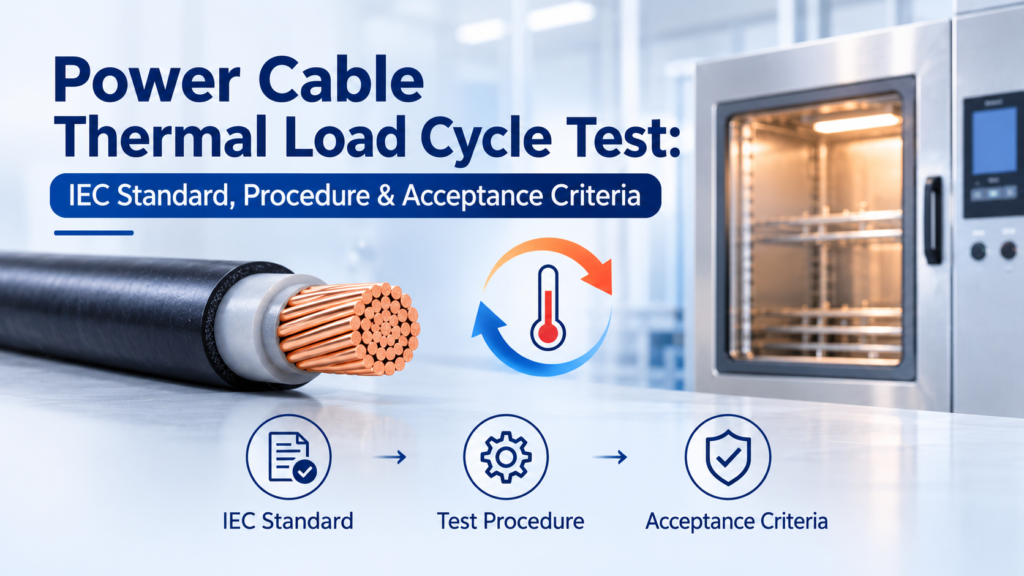
Unlike a simple continuous temperature ageing test, this test simulates daily load fluctuation, which is a major root cause of structural degradation for cables serving renewable energy plants and urban distribution feeders. When the cable conductor is heated close to its maximum permitted operating temperature and then naturally cooled down repeatedly, thermal expansion and contraction occur inside the cable structure.
The insulation, semiconductive layer and metal sheath all expand at different coefficients. Over many cycles, micro‑gaps may form at the insulation‑screen interface. If these defects are not identified during factory testing, they will gradually develop into serious faults after commissioning. You can check our previous article about partial discharge detection to understand how these hidden defects are detected after thermal cycling.
Standard Test Procedure
| IEC standard | Voltage class | Test name | Cycles | Cooling period |
|---|---|---|---|---|
| IEC 60502-2 | MV 6–30 kV | Heating cycle test (then PD test) | 20 | At least 3 h natural cooling |
| IEC 60840 | HV >30–150 kV | Heating cycle voltage test (2U₀ applied while heating) | 20 | At least 16 h |
| IEC 62067 | EHV >150–500 kV | Heating cycle voltage test; separate 8,760 h prequalification test | 20 type cycles | At least 16 h |
The test sequence differs slightly by standard. Under IEC 60840 and IEC 62067, the heating cycle voltage test runs for 20 cycles: the conductor is held 5–10 °C above its maximum operating temperature for at least 8 hours, cooled naturally for at least 16 hours, and a voltage of 2U₀ is applied during the heating period; partial discharge and tan delta measurements are taken before the heating cycle, followed after it by lightning impulse and power-frequency voltage tests. Under IEC 60502-2, the heating cycle test also runs 20 cycles, with at least 8 hours heating and at least 3 hours natural cooling, followed by a partial discharge test on the sample.
Many buyers confuse thermal load cycle test with ordinary thermal ageing test. Thermal ageing focuses on long‑term constant high‑temperature degradation of polymer materials, while thermal cycling targets cyclic mechanical stress from repeated temperature change. This difference is especially important for projects with obvious peak‑valley load, such as solar farms, wind power bases and urban distribution networks.
Common Failure Modes After Thermal Cycling
Common non‑conformities found after thermal cycling include stable partial discharge signals, sheath cracking, adhesion failure between insulation and semicon layer, and abnormal dielectric loss rise. For cable suppliers, passing this test proves the cable structure design and extrusion process are stable enough for variable load scenarios. If your project has frequent load changes, we recommend prioritizing cables that have successfully completed full thermal cycle type tests.
For official introduction of the test rules for extruded HV cable systems, refer to the document from CIGRE on AC cable prequalification tests. Our team supplies medium voltage, high voltage and extra-high voltage cables complying with IEC standards, supporting full type test reports for tender submission and site acceptance. Contact us to get technical datasheets and quotation for your power project.
FAQ
Q1: Must the thermal cycle test run 20 cycles?
For medium, high and extra-high voltage extruded cables, 20 heating cycles are generally required under IEC 60502-2, IEC 60840 and IEC 62067. For EHV cable systems above 150 kV, IEC 62067 also defines a separate long-duration prequalification test of about 8,760 hours of thermal cycling under voltage. This is a qualification campaign for the complete cable system, not the 20-cycle routine type test.
Q2: Is the heating cycle test mandatory for low-voltage cables such as YJV?
No. Low-voltage cables covered by IEC 60502-1 (1 kV to 3 kV) do not include a heating cycle type test. The heating cycle type test applies to screened medium-voltage cables under IEC 60502-2 and to HV/EHV cable systems under IEC 60840 and IEC 62067.
Q3: Does a failed thermal cycle test mean the cable cannot be used at all?
Failing this type test indicates structural risks under cyclic temperature and load stress. It is not recommended for critical main grid lines and new energy collection circuits.
Send us your project voltage, load profile and installation method. Our engineers will recommend suitable cable types and share valid type test records.