
Cable Insulation Resistance Test: Procedure, Standards & Acceptance Guide
Insulation resistance testing is the most common field check performed before energizing a new cable and during periodic maintenance. It measures how well the insulation blocks leakage current between conductors, and between conductor and shield or armour. A low or falling insulation resistance reading reveals moisture ingress, insulation ageing, joint defects or sheath damage long before a visible fault appears. This guide explains the test procedure, instrument voltage selection, standards and how to interpret the results for low and medium voltage power cables.
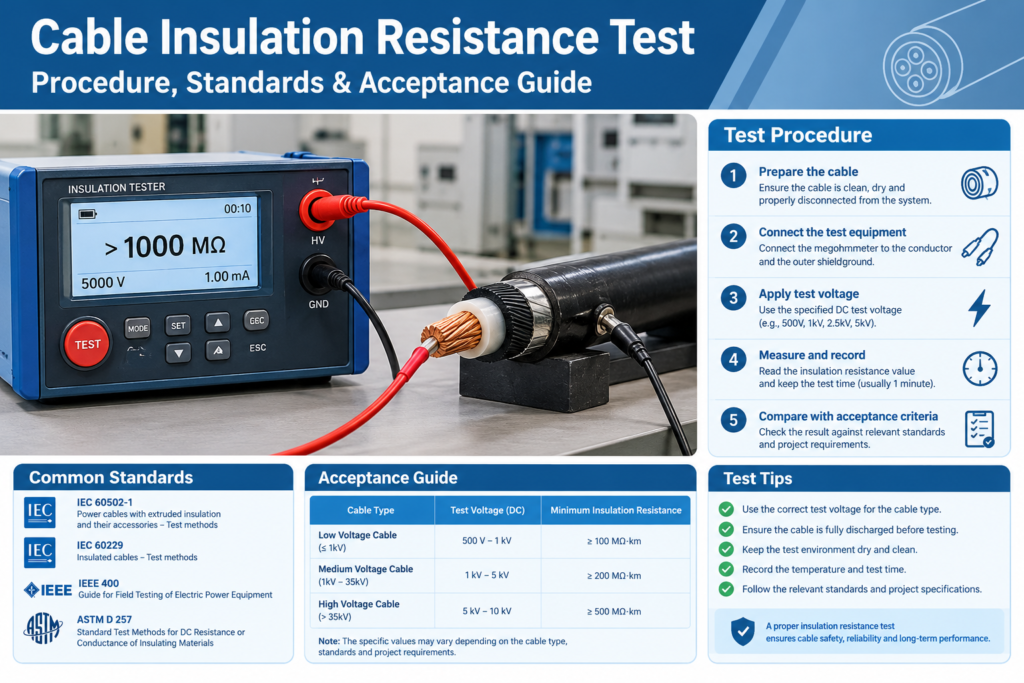
What Is Cable Insulation Resistance
Insulation resistance (IR) is the ratio of the applied DC test voltage to the steady leakage current flowing through the insulation, expressed in megaohms (MΩ). It is measured with a hand-cranked or electronic megohmmeter, commonly called a megger.
The test does not prove the insulation can withstand operating voltage forever; it gives a relative health reference. The most meaningful comparison is between today’s reading, the factory delivery value and previous maintenance readings on the same cable, adjusted for temperature.
Test Voltage Selection by Cable Voltage Class
The megger output voltage must match the cable rated voltage. Applying too high a voltage can stress healthy insulation; too low a voltage may miss real defects.
表格
| Cable rated voltage | Recommended DC tester voltage | Typical application |
|---|---|---|
| Up to 1 kV (LV) | 500 V or 1,000 V | Low voltage building and distribution cables |
| 1 kV – 10 kV (MV) | 2,500 V | Medium voltage distribution and plant cables |
| 10 kV – 35 kV (MV/HV) | 5,000 V | Substation and utility cable systems |
Final tester voltage and acceptance limits must follow the project specification, cable manufacturer data and local wiring code.
Standard Test Procedure
Preparation and Safety
- Disconnect all supply, load, switchgear and sensitive electronic equipment from the cable before testing.
- Discharge the cable capacitance fully before and after the test; charged cable cores can retain a dangerous DC voltage for a long time.
- Clean cable ends and surface pollution; dirty or damp terminal surfaces create false low readings.
- Record ambient temperature and humidity, because insulation resistance drops sharply as temperature and moisture rise.
Measurement Points
- Conductor to conductor, phase to phase
- Each phase to metallic shield / armour / sheath
- Shield or armour to ground, when checking sheath integrity
Readings and Indices
- Take the 15-second and 60-second readings; the absorption ratio (R60 / R15) indicates whether insulation is dry or moisture-laden.
- For longer-term assessment, the polarization index (PI = 10-minute reading / 1-minute reading) is recorded on medium and high voltage cable systems.
Standards Referenced
- IEC 60502-1 and IEC 60502-2 cover extruded-insulation power cables from 1 kV up to 30 kV, including factory routine and electrical test requirements.
- IEEE 400-2023 provides guidance for field testing and evaluation of the insulation of shielded power cable systems rated 5 kV and above.
- IEEE 400.2-2024 describes very low frequency (VLF) field testing used as a complementary diagnostic for medium voltage cables.
What a Low or Declining Reading Means
A low insulation resistance reading points to a limited set of causes:
- Moisture ingress: broken sheath, poorly sealed joints or burial in wet soil. This is the most common cause and often ties into earlier sheath corrosion and water treeing problems.
- Insulation ageing: accumulated thermal cycling and long-term electrical stress degrade XLPE over years.
- Joint or terminal defects: trapped air, dust, moisture or poor crimping at cable accessories.
- Surface leakage: pollution or humidity on exposed terminal surfaces.
A weak IR reading often precedes partial discharge development. If IR is poor, further diagnostic testing such as VLF or partial discharge measurement should be arranged before energizing the cable.
How IR Testing Relates to Other Cable Checks
Insulation resistance, cable ampacity and voltage drop answer different questions:
- IR test: Is the insulation healthy?
- Ampacity check: Can the conductor carry the load current without overheating?
- Voltage drop check: Will the load receive acceptable voltage at the end of the run?
They complement each other during design, factory acceptance and site handover. No single test replaces the others.
Practical Tips for Reliable Readings
- Compare readings to the same cable’s history, not to an absolute universal number, because conductor size, length, insulation material and temperature all affect IR.
- Convert readings to a reference temperature when trending past and current results.
- Keep cable ends dry during the test; surface leakage can mask a healthy core.
- Repeat the test after rain, flooding or sheath repairs to confirm moisture has cleared.
FAQ
1.Is a high insulation resistance reading enough to put the cable into service?
No. A good IR reading is one condition of acceptance, but medium voltage cable systems also require withstand or VLF testing and, where specified, partial discharge assessment according to project standards.
2.Does a long cable naturally show lower insulation resistance?
Yes. Longer cable length means larger insulation surface and higher total leakage current, so the measured MΩ value drops. Readings should always be compared against the same cable length and installation history.
3.Can insulation resistance rise again after moisture removal?
Partially. Once water has formed deep water trees inside XLPE, the damage is permanent and the IR reading will not fully recover. External surface moisture can be dried out, but internal insulation degradation cannot be repaired.
4.What instrument voltage do I use on a 10 kV cable?
For a 10 kV medium voltage cable, a 2,500 V DC megger is the typical starting point. Confirm the exact test voltage and acceptance value with the cable supplier and project specification before testing.
Request Testing Advice for Your Cable System
We supply LV and MV power cables and XLPE power cables with factory test records, and we support customers with insulation resistance, withstand voltage and acceptance test recommendations. Share your cable voltage, length, laying condition and maintenance schedule, and our technical team will advise the correct test sequence and acceptance criteria.