
Selecting the correct power cable size is essential for ensuring electrical safety, reliable power transmission and long-term system performance.
An incorrectly sized cable may cause excessive voltage drop, overheating, energy loss or safety risks. Engineers, contractors and purchasing teams need to consider multiple factors before selecting a suitable cable size.
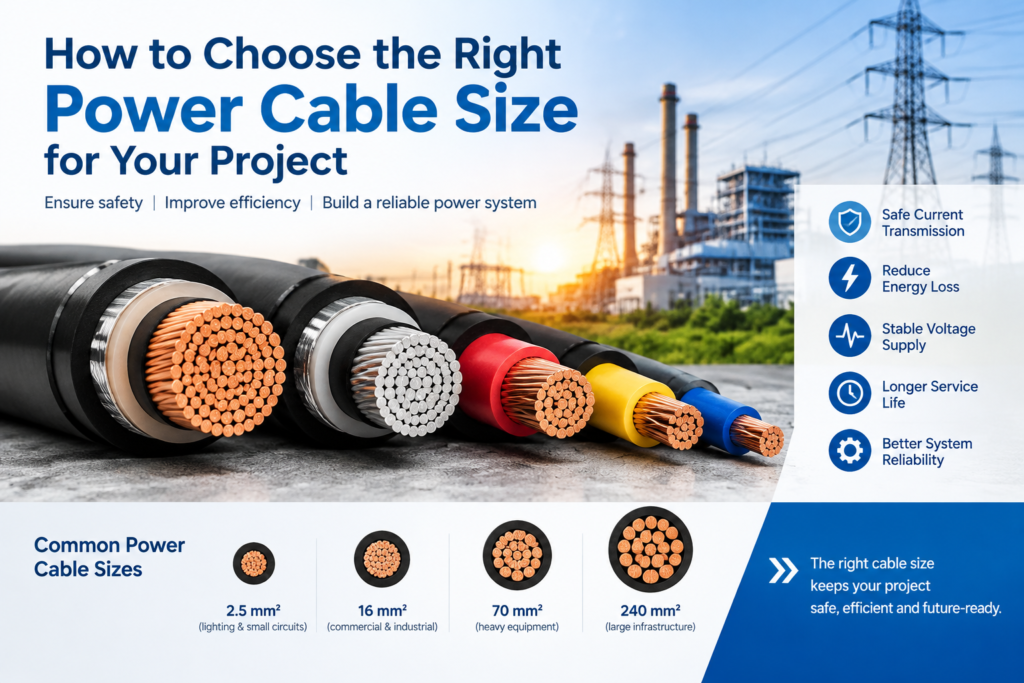
1. Why Is Power Cable Size Important?
The cable size directly affects electrical performance. A properly selected cable provides safe current transmission, reduced energy loss, stable voltage supply and longer service life.
Undersized cables may cause overheating, increased voltage drop, insulation damage and reduced lifespan.
2.Understand Cable Cross-Sectional Area
Cable size is usually expressed by conductor cross-sectional area in mm².
Common sizes include:
1.5 mm², 2.5 mm², 4 mm², 6 mm², 10 mm², 16 mm², 25 mm², 35 mm², 50 mm², 70 mm², 95 mm² and larger sizes.
3. Consider Load Current Requirement
The cable must safely carry the required current without exceeding temperature limits.
Important factors include:
– Electrical load
– Operating voltage
– Single-phase or three-phase system
– Installation method
– Ambient temperature
4.Consider Voltage Drop
Voltage drop increases with cable length and current. A larger conductor size can reduce resistance and improve voltage stability.
5.Copper vs Aluminum Cable Selection
Copper cables provide higher conductivity and flexibility.
Aluminum cables provide lower weight and cost advantages, making them suitable for large power transmission projects.
6. Cable Insulation and Installation Environment
Cable selection should consider installation conditions.
Indoor:
– Heat dissipation
– Fire safety
– Installation flexibility
Underground:
– Moisture resistance
– Mechanical protection
– Armored structure
Industrial:
– Temperature resistance
– Long-term operation
– Durability
XLPE insulated power cables are widely used for demanding applications due to excellent thermal and electrical performance.
7. Common Power Cable Size Applications
Small sizes: Lighting and small electrical circuits
Medium sizes: Commercial and industrial distribution
Large sizes: Heavy equipment and infrastructure projects
8.International Standards
Global projects may require compliance with:
– BS standards
– ASTM standards
9. Why Work with a Professional Cable Manufacturer?
A reliable cable supplier can provide cable size recommendations, customized solutions, technical documentation, inspection reports and export support.
Conclusion:
Choosing the right power cable size requires evaluation of current capacity, voltage drop, conductor material, insulation type and installation environment.
Frequently Asked Questions:
1. How do I calculate the correct power cable size?
Cable size depends on load current, voltage level, cable length, installation conditions and allowable voltage drop.
2. Does a larger cable size always mean better performance?
Not necessarily. Cable size should match electrical requirements.
3. What cable size is commonly used for industrial applications?
Industrial applications often use medium and large conductor sizes depending on power requirements.
4. Is copper cable better than aluminum cable?
Copper provides higher conductivity while aluminum offers weight and cost advantages.
5. Can cable manufacturers provide customized sizes?
Yes. Manufacturers can customize cable sizes, structures and specifications.
Request a Cable Solution:
Need help selecting the right cable size for your project?
Contact us for professional cable specifications and quotation.