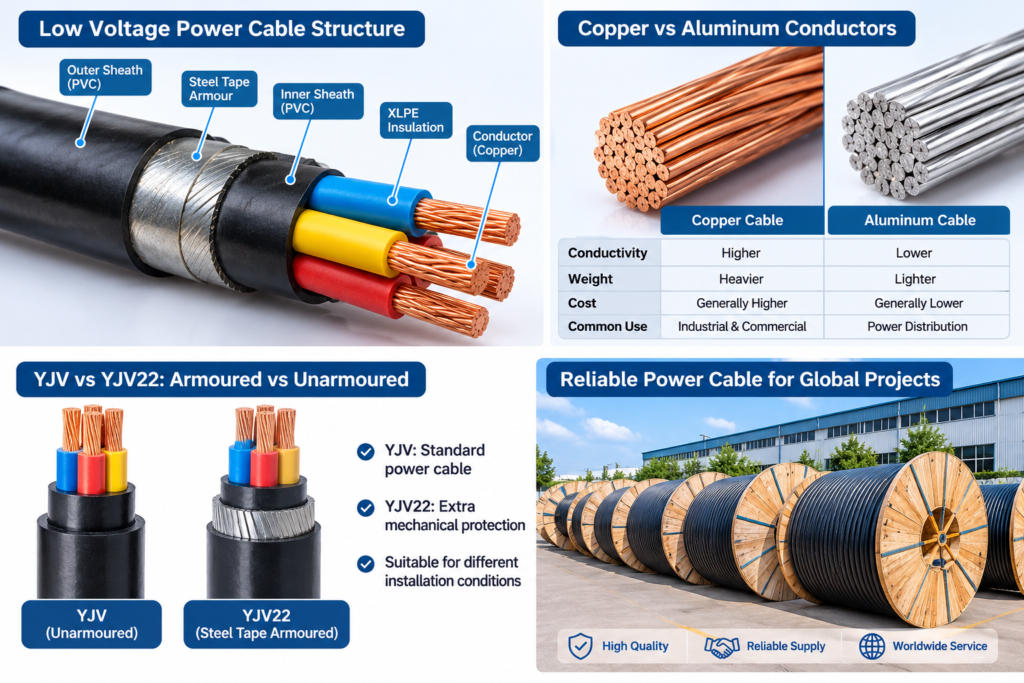
Choosing the right low voltage power cable is essential for electrical safety, reliable power transmission, and long-term operating performance. Whether you are working on an industrial installation, commercial building, infrastructure project, or power distribution network, selecting the correct cable requires more than simply choosing a conductor size.
In this guide, we explain the key factors to consider when selecting low voltage power cables, including conductor materials, insulation types, cable construction, installation conditions, and applicable standards.
The first step in selecting a power cable is identifying the operating voltage of your electrical system.
Low voltage power cables are commonly used in:
For many industrial and commercial applications, 0.6/1kV power cables are widely used.
Common cable designations include:
| Cable Type | Typical Construction | Common Application |
|---|---|---|
| YJV | Copper / XLPE / PVC | Fixed power installations |
| YJLV | Aluminum / XLPE / PVC | Power distribution |
| YJV22 | Copper / XLPE / Steel Tape Armor / PVC | Underground installations |
| YJLV22 | Aluminum / XLPE / Steel Tape Armor / PVC | Underground power distribution |
The appropriate cable voltage rating must be compatible with the electrical system and the applicable installation requirements.
For international projects, IEC 60502-1:2021 specifies construction, dimensions, and testing requirements for extruded-insulation power cables rated at 1kV and 3kV for fixed installations.
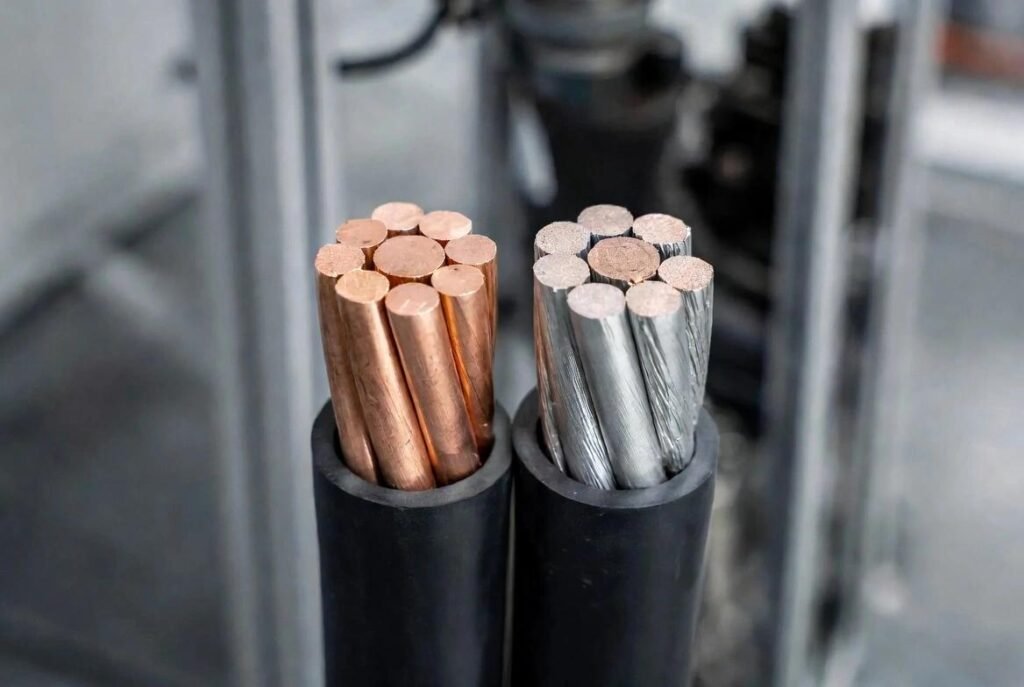
Conductor material is one of the most important decisions when purchasing power cables.
Copper and aluminum are both widely used in power transmission and distribution. Each offers different advantages depending on the project requirements.
Copper has high electrical conductivity and excellent mechanical properties.
Main advantages:
Copper cables are commonly selected for industrial installations, commercial buildings, equipment connections, and applications where installation space and electrical performance are important.
Aluminum is lighter than copper and can provide an economical solution for many power distribution applications.
Main advantages:
However, aluminum conductors generally require a larger cross-sectional area than copper conductors for comparable electrical performance. Appropriate terminals, connectors, and installation practices are also important.
| Parameter | Copper | Aluminum |
|---|---|---|
| Electrical conductivity | Higher | Lower |
| Weight | Heavier | Lighter |
| Conductor size | Generally smaller | Generally larger |
| Material cost | Generally higher | Generally lower |
| Mechanical properties | Higher strength | Different mechanical characteristics |
| Common applications | Industrial and commercial installations | Power distribution and large cable systems |
Our recommendation: Do not select copper or aluminum based on material price alone. Consider current-carrying capacity, voltage drop, cable dimensions, installation requirements, connection methods, and total project cost.
Cable insulation protects conductors from electrical contact, leakage current, and environmental influences.
The two commonly used insulation materials in low voltage power cables are PVC and XLPE.
PVC (Polyvinyl Chloride) is widely used in conventional power cables.
Advantages include:
PVC-insulated cables are suitable for many standard electrical distribution applications when their temperature and installation ratings meet project requirements.
XLPE (Cross-Linked Polyethylene) is widely used in industrial and power distribution cables.
Advantages include:
For many XLPE power cables, the maximum normal conductor operating temperature is 90°C, subject to the applicable cable standard and design.
| Parameter | PVC | XLPE |
|---|---|---|
| Material | Polyvinyl Chloride | Cross-Linked Polyethylene |
| Typical maximum conductor temperature | 70°C | 90°C |
| Thermal performance | Standard | Higher |
| Common applications | General electrical installations | Industrial and power distribution |
| Relative material cost | Generally lower | Generally higher |
The final selection should consider operating temperature, short-circuit conditions, environmental requirements, and the applicable cable specification.
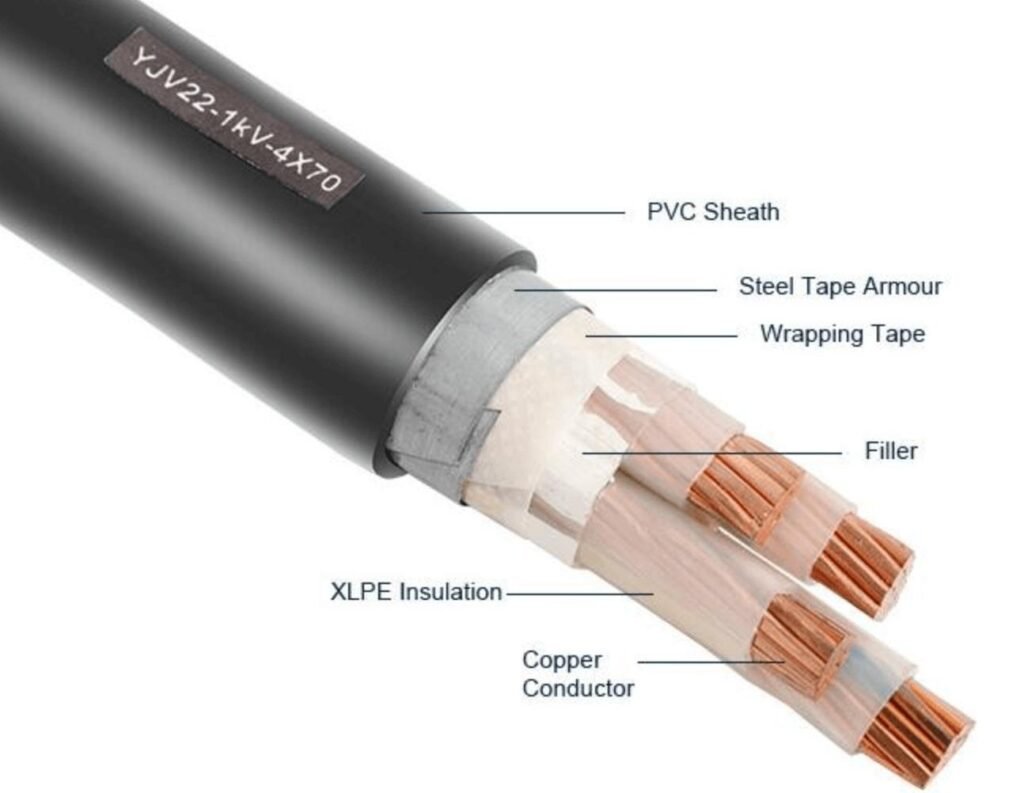
Another important consideration is whether the cable needs mechanical protection.
Armoured cables are often selected for installations where cables may be exposed to external mechanical damage.
Unarmoured cables are generally used in:
Armoured cables provide additional mechanical protection and are commonly used in underground and industrial installations, depending on the installation design.
Two common constructions include:
Steel Tape Armoured Cable (STA)
Steel Wire Armoured Cable (SWA)
The choice between STA, SWA, and unarmoured construction depends on the installation environment, mechanical protection requirements, cable design, and local regulations.
For example, YJV22 is a commonly used designation for copper-conductor XLPE-insulated, steel-tape-armoured, PVC-sheathed power cable.
Selecting the correct conductor size is essential for electrical safety and reliable operation.
Common low voltage power cable sizes include:
However, the conductor cross-sectional area should never be selected based only on the equipment’s rated power.
Professional cable selection should consider:
1. Current-Carrying Capacity
The cable must safely carry the expected operating current without exceeding its permitted conductor temperature.
2. Voltage Drop
The voltage drop along the cable must remain within the limits specified by the project design and applicable electrical regulations.
3. Short-Circuit Withstand Capacity
The conductor must withstand the thermal effects of the expected short-circuit current for the specified protection-clearing time.
4. Installation Conditions
Cable installation methods, ambient temperature, grouping, soil thermal resistivity, and burial conditions can all affect current-carrying capacity.
For this reason, final cable sizing should be verified by a qualified electrical engineer using the applicable standards and project requirements.
A cable that performs well in one environment may not be suitable for another.
Before placing an order, consider the following factors:
| Installation Condition | Important Considerations |
|---|---|
| Underground installation | Armour, moisture protection, soil conditions |
| Indoor installation | Fire performance, smoke requirements, installation method |
| Outdoor installation | UV exposure, weather resistance, sheath material |
| Industrial environments | Mechanical protection, temperature, chemicals |
| Cable trays | Cable grouping, support, installation conditions |
For projects with specific fire safety requirements, buyers should also confirm whether flame-retardant, low-smoke, or halogen-free cable constructions are required.
These properties are not interchangeable. The exact fire-performance classification and supporting test documentation should be confirmed against the project specification.
International projects often require compliance with specific cable standards.
Some commonly referenced standards include:
| Standard | Main Scope |
|---|---|
| IEC 60502-1 | Extruded-insulation power cables rated 1kV and 3kV |
| IEC 60228 | Conductors of insulated cables |
| IEC 60332 Series | Tests on electric and optical fibre cables under fire conditions |
The required standard depends on the project location, application, and buyer’s technical specifications.
Before purchasing, confirm:
A cable’s designation alone does not guarantee that it meets every project requirement.
To obtain an accurate quotation and avoid unnecessary technical revisions, buyers should provide as much of the following information as possible.
| Required Information | Example |
|---|---|
| Cable type | YJV / YJV22 |
| Rated voltage | 0.6/1kV |
| Conductor material | Copper / Aluminum |
| Number of cores | 3-core / 4-core / 5-core |
| Cross-sectional area | 3 × 185 mm² |
| Insulation | XLPE |
| Armour | Unarmoured / STA / SWA |
| Outer sheath | PVC / LSZH |
| Quantity | 5,000 meters |
| Applicable standard | IEC 60502-1 |
| Delivery destination | Destination port or delivery address |
If you have a technical specification, drawing, bill of quantities (BOQ), or existing cable datasheet, sharing it with your supplier can help ensure that the proposed cable construction matches your requirements.
Q1: What is the difference between YJV and YJV22 cables?
YJV generally refers to copper-conductor, XLPE-insulated, PVC-sheathed power cable without armour. YJV22 adds a steel tape armour layer beneath the outer PVC sheath, providing additional mechanical protection.
Q2: Is XLPE better than PVC for power cables?
Neither material is universally better. XLPE offers a higher typical maximum conductor operating temperature and is widely used in industrial power distribution. PVC is often a cost-effective solution for general electrical applications. The correct choice depends on the operating conditions and project requirements.
Q3: Can aluminum cables replace copper cables?
In many power distribution applications, aluminum cables can be used as an alternative to copper cables. However, the conductor size must be properly recalculated, and suitable terminals and installation practices must be applied.
Q4: Do all underground power cables need armour?
Not necessarily. Armour requirements depend on mechanical protection, installation conditions, local electrical regulations, and project specifications. The cable construction should be selected accordingly.
Q5: What is the most commonly used voltage rating for industrial low voltage power cables?
0.6/1kV is a common rated voltage for industrial and commercial power distribution cables. However, the actual rating must match the electrical system and applicable standards.
Choosing the right low voltage power cable requires a comprehensive understanding of electrical requirements, conductor materials, insulation properties, mechanical protection, and installation conditions.
A properly selected cable can help improve system reliability, reduce unnecessary installation costs, and support long-term operating performance.
At Hunan Yidong Crosslinked Cable Co., Ltd., we work with international buyers on power cable sourcing and project requirements.
Whether you need copper or aluminum conductors, XLPE or PVC insulation, armoured or unarmoured power cables, providing your technical specifications and project details is the first step toward identifying a suitable cable solution.
Looking for a reliable low voltage power cable supplier?
Contact our team to discuss your cable requirements and request a quotation.
Website: https://yidongjiaolian.com
Email: info@yidongjiaolian.com