
Industry Operation Data: More than 60% of cable overheating, insulation aging and tripping faults are not caused by insufficient wire gauge, but by unreasonable ampacity derating. Many engineers use standard open-air ampacity directly for dense laying and high-temperature environments, resulting in long-term overload operation.
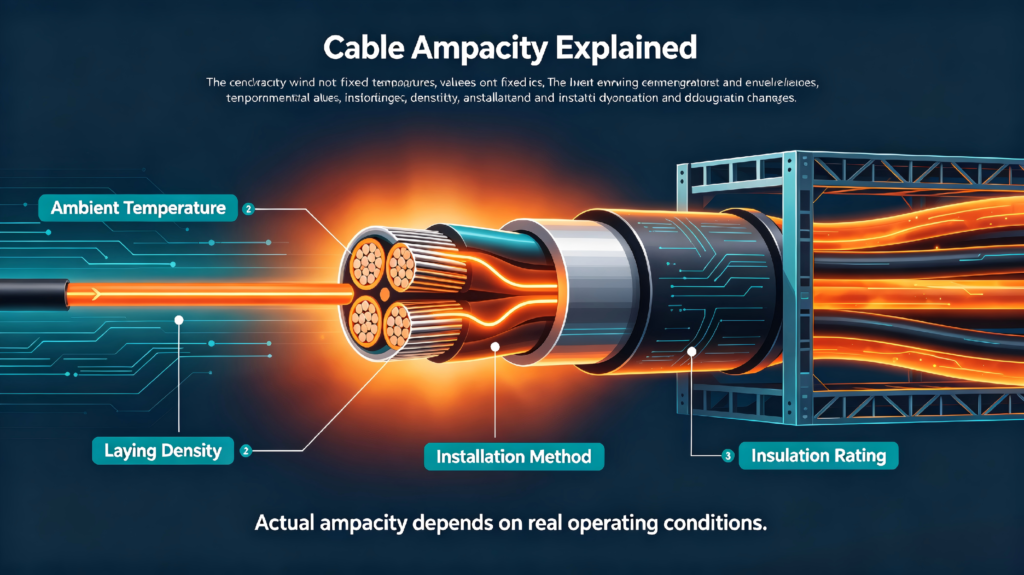
Cable ampacity, also known as current carrying capacity, refers to the maximum safe current that a power cable can continuously carry under specific laying and temperature conditions. It is the most fundamental basis for wire size selection, load matching and power distribution design.
In actual engineering, the theoretical ampacity listed in cable manuals only applies to ideal open and single laying environments. Once the cables are laid in batches, installed in closed bridges, or operated in high-temperature environments, the effective ampacity will drop significantly. Understanding ampacity influencing factors and derating rules can effectively avoid cable overload heating, insulation damage and fire risks.
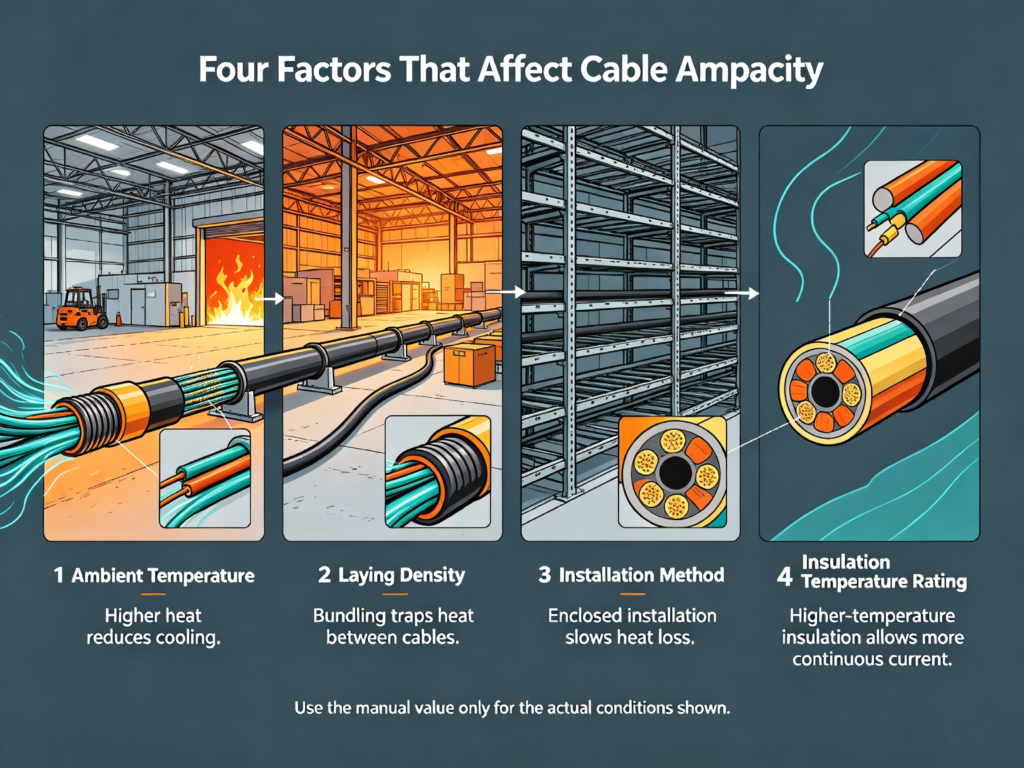
1. Four Core Factors That Affect Cable Ampacity
Cable current carrying capacity is not fixed. Its actual value changes with ambient temperature, laying density, installation method and cable structure. The four most influential factors are summarized below:
- Ambient Temperature: High external temperature reduces the cable’s heat dissipation efficiency. The higher the ambient temperature, the lower the allowable continuous current. Cables working in outdoor sunlight, boiler rooms and closed pipe trenches have significantly decreased ampacity.
- Laying Density: Single cable laying has the best heat dissipation. When multiple cables are bundled or densely arranged in trays, mutual heat accumulation causes temperature rise and reduces overall current carrying capacity.
- Installation Method: Cables in open air have good ventilation and heat dissipation. Buried cables, pipe threading and fully enclosed bridge laying block heat dissipation, leading to obvious ampacity attenuation.
- Cable Insulation Temperature Rating: Different sheath and insulation materials have different maximum long-term operating temperatures. High-temperature resistant cables allow larger ampacity, while ordinary low-temperature insulation cables have stricter current limits.
2. Universal Cable Derating Coefficient Table by Environment
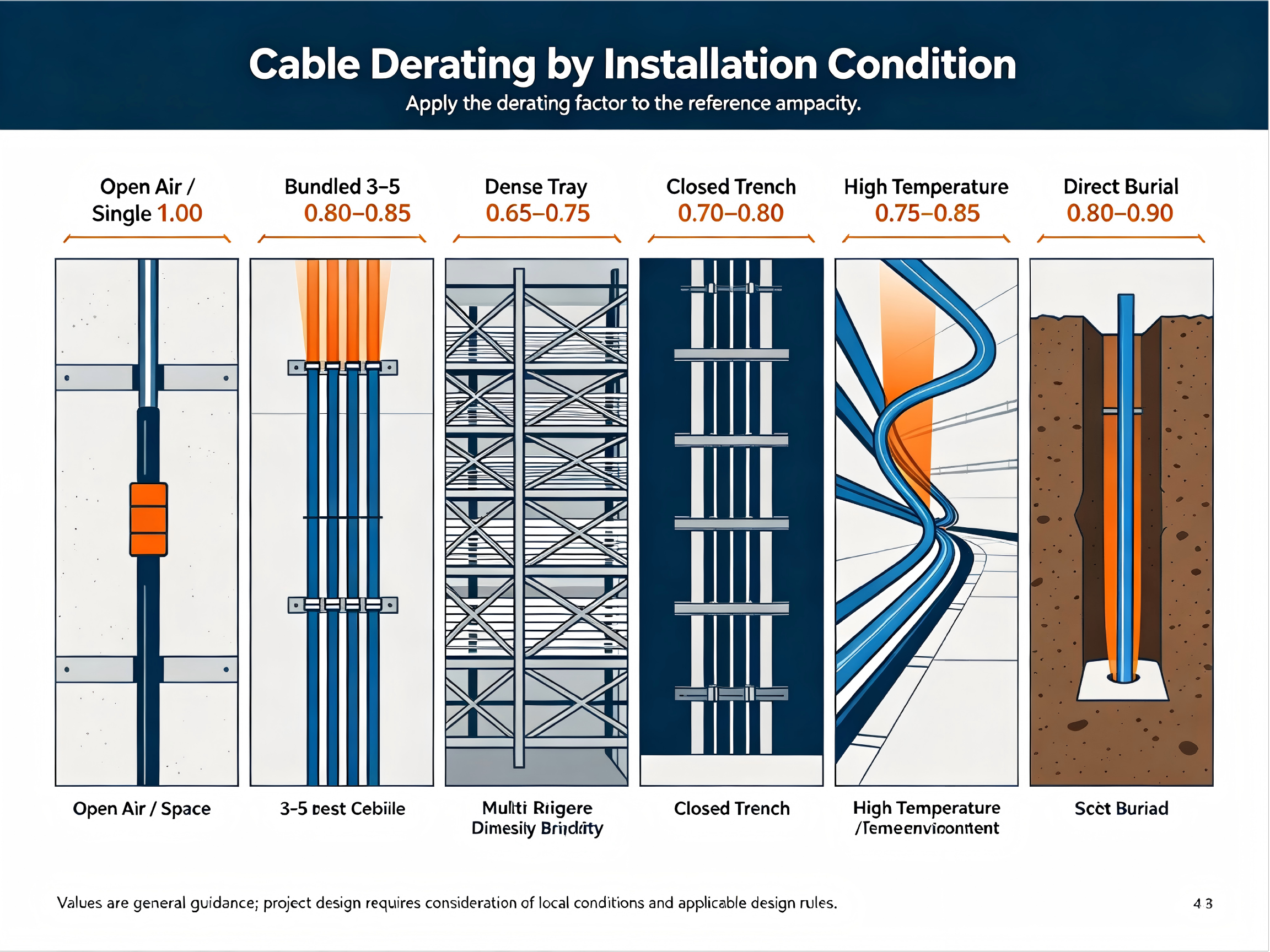
In practical engineering, standard ampacity must be multiplied by the corresponding derating coefficient according to the actual working conditions. The following coefficients are universally recognized industry empirical values for daily cable design and construction:
| Working Environment | Derating Coefficient | Practical Explanation |
| Open air, single laying, normal temperature | 1.0 | Ideal state, use standard ampacity directly |
| Dense bundled laying (3–5 cables) | 0.80 – 0.85 | Heat accumulates between cables, current must be reduced by 15%–20% |
| Multi-layer bridge dense laying (more than 6 cables) | 0.65 – 0.75 | Severe heat stacking, ampacity drops by nearly 30% |
| Closed pipe gallery / fully enclosed trunking | 0.70 – 0.80 | No air convection, poor heat dissipation |
| High temperature environment above 35°C | 0.75 – 0.85 | External temperature reduces heat dissipation difference |
| Direct buried underground laying | 0.80 – 0.90 | Soil heat dissipation is stable but slower than open air |
3. Insulation Temperature Rating and Ampacity Performance
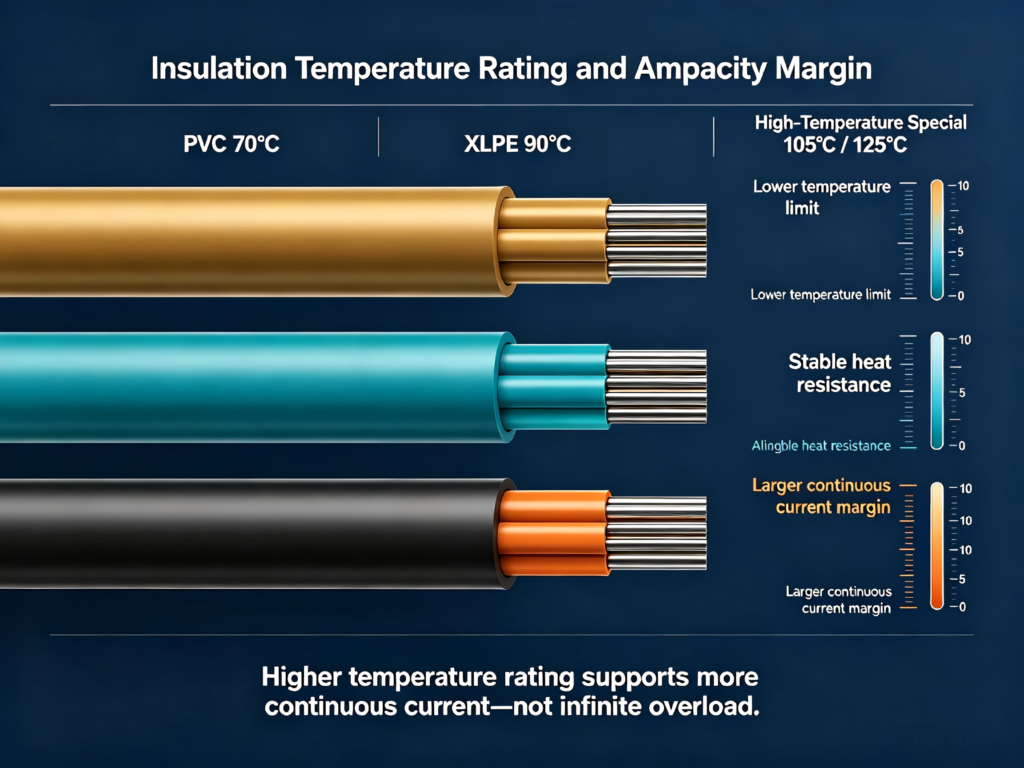
The maximum allowable working temperature of cable insulation directly determines the upper limit of continuous current. Different cable types have different temperature resistance levels, which is an important basis for high-load scenario selection:
| Cable Insulation Type | Max Long-Term Working Temperature | Ampacity Performance Feature | Applicable Scenarios |
| PVC Insulation | 70°C | Low temperature resistance, small safe current margin | Ordinary indoor low-load wiring, normal temperature environment |
| XLPE Crosslinked Insulation | 90°C | Higher allowable ampacity, stable heat resistance | Industrial power distribution, long-term continuous operation lines |
| High-temperature Resistant Special Cable | 105°C / 125°C | Largest current carrying margin, strong overload resistance | High-temperature workshops, equipment internal wiring, special industrial environments |
4. Common Engineering Mistakes in Ampacity Selection
Core Engineering Taboo: Never apply standard open-air ampacity to densely laid or fully enclosed cables. Ignoring derating factors is the leading cause of cable insulation aging and spontaneous combustion risks.
- Only increasing wire size without considering heat dissipation: Many projects simply use larger cables to solve overload problems, but ignore closed laying environments, still causing continuous overheating.
- Uniform current value for all scenarios: Using the same ampacity parameter for both single open laying and dense bridge laying leads to serious hidden overload dangers.
- Confusing temperature resistance grades: Replacing high-temperature resistant cables with ordinary PVC cables in high-temperature workshops, resulting in accelerated insulation aging.
- Ignoring long-term aging attenuation: Cable ampacity will slightly decrease after long-term aging. Long-term operation projects must reserve a certain current margin.
5. Practical Ampacity Selection Guidelines
- Open and sparse wiring: Adopt standard ampacity values, and reserve 10% current margin for long-term operation.
- Bridge dense laying: Strictly perform derating calculation according to the number of cables, prioritize XLPE cables with better heat resistance.
- High temperature workshop and outdoor exposure: Use high-temperature resistant cables and reduce actual carrying current properly.
- Key power supply lines: Multi-layer derating calculation is required for lines with high continuity requirements to avoid long-term overload fatigue.
6. Conclusion
Cable ampacity is not a fixed parameter, but a dynamic value affected by temperature, laying density and installation methods. Reasonable derating calculation and scenario-based wire selection are the key to avoiding cable overheating faults and extending service life. Mastering ampacity derating rules can help engineers balance safety margin and project cost, realizing more scientific and standardized power distribution design.
Hunan Yidong Crosslinked Cable provides PVC, XLPE and high-temperature resistant series cables with stable current carrying performance, matching different laying environments and load requirements. We support professional cable type selection and load matching solutions for industrial, construction and municipal power projects.
Official Website: https://yidongjiaolian.com